
Last updated: November 2026
Quick answer: To buy a used CTP machine safely, define the plate sizes and technology you need, verify the seller and machine ownership, watch the machine image your own test file, calculate the full landed cost, then hold back part of the payment until it passes an acceptance test at your site. CTPPress can also supply a refurbished machine with a 2-year warranty that includes the laser head, and these checks apply to any seller, including us.
Key takeaways
- A low listing price proves nothing. Judge the deal on a live imaging test, verified ownership, landed cost and a named installer.
- Test with your own file, on the seller’s machine, before anyone unplugs it. A machine that is already dismantled cannot be verified.
- Get a written price for a laser head replacement and keep that amount as a reserve in your budget.
- Pay in stages, and link the last stage to an acceptance test at your site rather than to shipment.
- Ask who will install the machine, train your operators and respond when it stops. After-sales support matters as much as the machine’s condition.
A used platesetter can be a sound way to add CTP capacity, but buying one is closer to a small engineering project than a normal equipment purchase. The machine has to be tested, taken apart, shipped, rebuilt and recalibrated, often by people who have never worked together. Our new vs used CTP machine comparison covers whether to go used at all. This guide starts where that one ends: you want a used machine, so how do you buy it without being left with an expensive crate?
A word on our position. We are a plate and processing equipment manufacturer. We offer new platesetters supplied with our partner factories, and we also supply used machines, including to customers in Ghana, Nigeria and Uganda. Because we sell used machines ourselves, you should read this guide knowing that interest, and apply the same checks to any offer you receive from us.
Step 1: Define the machine you actually need
Write the specification before you look at listings. Otherwise a cheap machine starts to shape your requirements instead of the other way round.
- Format. Match your largest and smallest plate sizes to your presses, including any format you plan to add. Our 4-up vs 8-up CTP guide explains how format drives cost.
- Imaging technology. Thermal, violet and UV (CTcP) machines take different plates. Before you commit, confirm that plates for that technology are sold in your market at a fair price. Our thermal vs violet CTP comparison sets out the differences.
- Daily volume. Work out plates per shift and compare that with the speed the machine reaches today, not the speed in its old brochure. A head running with disabled channels can be slower than its rating.
- Automation. Decide whether you need an autoloader and an inline punch. These add parts that can fail, but manual loading may not suit a high daily volume.
- Service access. Name the engineer who can support this model in your country. If you cannot find one, that is a reason to drop the model, however good the price is.
Step 2: Choose where to buy a used CTP machine
Each channel trades price against protection. The term “refurbished” has no fixed meaning, so always ask for a written list of what was replaced and what was only cleaned.
| Source | Main advantage | Main risk | What to insist on |
|---|---|---|---|
| Printer selling directly | Machine is often still in production; you can talk to its operators | No warranty, and the seller has no experience of moving it | Live test, service records, your own dismantling crew |
| Used machinery dealer | Handles sourcing, crating and export paperwork | Machine may already be in a warehouse and impossible to test | Powered-up test, written condition report, short service terms |
| Manufacturer or authorised refurbisher | Parts, software and service route are clearest | Highest used price | List of replaced parts, warranty terms, licence transfer |
| Auction or insolvency sale | Lowest purchase price | Sold as-is; little time to test; no records | Budget as if the laser head needs replacing |
| Online marketplace or broker | Wide choice across countries | Hardest to verify; highest fraud risk | Proof of ownership, in-person or third-party inspection |
Step 3: Screen the seller before you travel
A short written questionnaire removes most bad offers for free. Send it before any inspection, and treat a vague or missing answer as an answer.
- Identity. What are the exact model, serial number, year of manufacture and format? Ask for a photo of the serial plate.
- Ownership. Can you show the original purchase invoice? Is the machine on lease, or pledged against a loan? A financed machine may not be the seller’s to sell.
- Current state. Is it installed and powered today? When did it last image a production plate?
- Laser history. What are the imaging hours, and when was the head or any laser diode last replaced? Is the service report available?
- Software. Which RIP and workflow version does it run? Are the licences transferable, and are the dongle and installation media included?
- Peripherals. Do the sale terms include the control computer, interface card, autoloader, punch, chiller, compressor and vacuum pump?
- Reason for sale. Why is it being sold, and can you speak to the operator or service engineer?
Then contact the manufacturer’s service department or a local agent with the serial number. Ask whether the model is still supported, which parts are no longer available, and what a licence transfer costs. “We cannot find an engineer for this old model” is a problem you want to discover at this stage, not after delivery. “The RIP dongle was not included” is another, and a single line in the sale terms prevents it.
Step 4: Run a live test on the machine
This is the step that matters most. “The seller says it was running until last week” is not evidence. You want to see the machine image plates today, using your file, before it is touched.
| Test | How to run it | What a failure looks like |
|---|---|---|
| Full-width imaging | Image your test form with a 50% tint across the largest plate, then develop it | Bands, stripes or density steps, which can point to weak or dead laser channels |
| Dot range | Image a 1% to 99% step wedge at your screen ruling and read it with a plate reader | Lost highlights, uneven readings across the plate, values that will not linearise |
| Fine detail | Image 1 and 2 pixel lines and small positive and negative type | Broken lines or soft edges, which can indicate focus or optics problems |
| Register repeatability | Image the same register marks on 3 plates and overlay them | Marks that shift from plate to plate, which can point to clamp, drum or punch wear |
| Plate handling | Run the smallest and largest plates, 5 cycles each, through any autoloader | Misfeeds, skewed plates, vacuum alarms, clamp errors |
| Diagnostics | Export the laser power report, error log and imaging hours | Reduced power, disabled channels, repeated faults, missing logs |
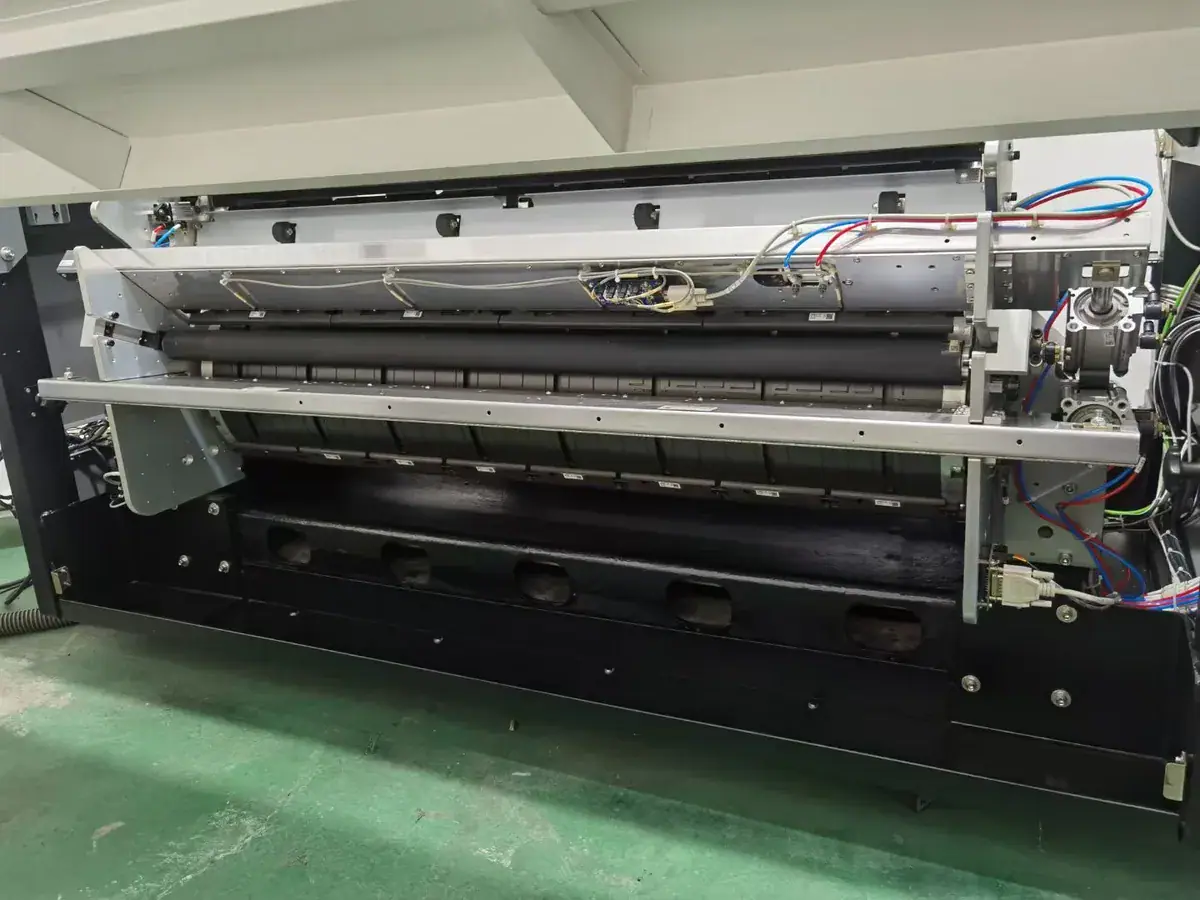
| Sound and condition | Listen at full drum speed; inspect belts, rails, filters and debris extraction | Vibration, grinding, oily residue, heavy dust around the optics |
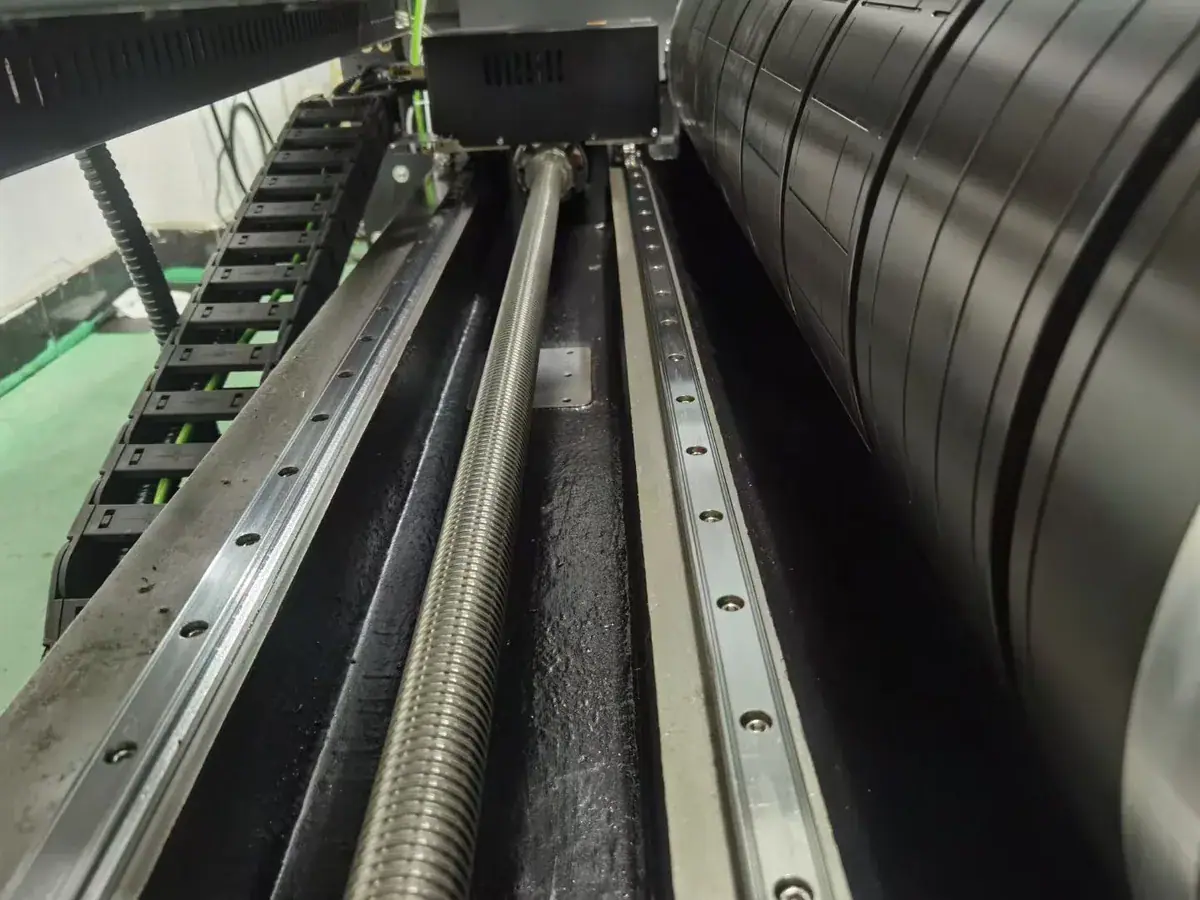
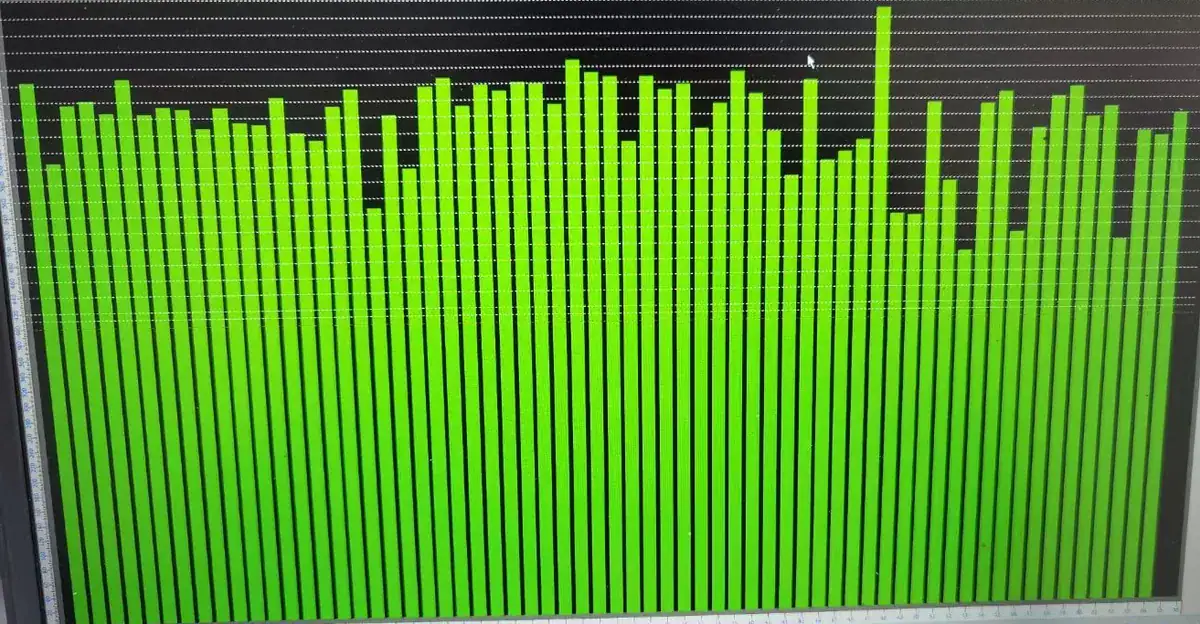
Bring plates of the type you intend to run, because a head with little power left may struggle with your plate at the normal drum speed. Our CTP plate exposure test shows how to find the right energy, and trial plates from your intended supplier make the result far more meaningful. Keep the test plates: they become your reference at the acceptance stage.
If you cannot fly in. “We do not have budget to fly someone to inspect” is a common objection, and there is a cheaper route than skipping the test. Pay a local service engineer or a third-party inspection company to attend. Alternatively, run a live video call in which the seller shows the serial plate and a dated page, images your file during the call, and couriers the plates to you. A recorded video alone is weak evidence, since “the machine worked in the video” says nothing about which machine it was or when.
If the seller will not wait. When “the dealer will not hold the price while we test”, offer a small holding deposit that is refundable in writing if the machine fails the agreed test. A seller who refuses any refundable arrangement is telling you something.
Step 5: Work out the full landed cost
To know the full cost before you commit, get a figure for every line below. Quote them in one currency and keep the written source for each. We leave out example prices on purpose, because used machine prices vary too widely by model, age, format and region for a general figure to be reliable.
| Cost line | Where the figure comes from |
|---|---|
| Machine and included peripherals | Seller’s written offer |
| Inspection and travel | Your engineer or inspection company |
| Dismantling, crating and loading | Engineer and packing contractor |
| Freight and cargo insurance | Freight forwarder |
| Import duty, tax and inspection fees | Customs broker, in writing |
| Installation, calibration and training | Named service engineer |
| RIP licence transfer or new RIP | Manufacturer or software dealer |
| Laser head reserve | Written replacement quote for this model |
| First-year spare parts | Parts supplier, from the engineer’s list |
| Site work and processor | Your electrician and processor supplier |
| Lost production during the switch | Your own plate volume and margin |
Now compare that total with a quote for a comparable new machine, using our CTP machine price guide to see which factors move the figure. If the used total is close to the new quote, the used machine has stopped being a bargain, because you would be taking on more risk for a similar price. Set your walk-away figure before you negotiate.
Check import rules early. Some countries restrict used machinery by age, require a pre-shipment inspection certificate, or apply different treatment to second-hand goods. These rules change, so ask a customs broker in your country to confirm them in writing before you pay a deposit.
Should you buy the processor used too?
A platesetter is only half of the line. The plate still has to be developed, gummed and dried consistently, so budget and test the two machines together.
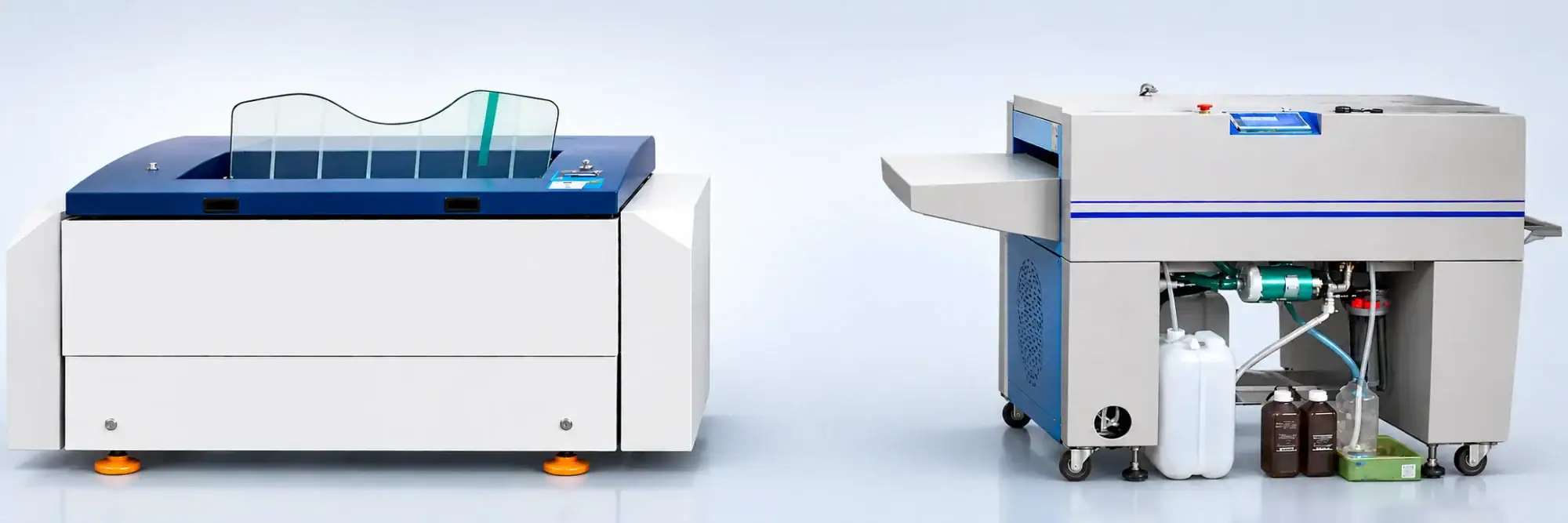
A used processor is often the weaker half of the deal. Years of contact with alkaline developer wear rollers, brushes, pumps, seals and heaters, and those faults show up as uneven development that is easily blamed on the plate or the laser. If you do buy one, run plates through it during the test and inspect the tank, brushes and replenishment system. Pairing a used platesetter with a new processor is a reasonable alternative. We manufacture plate processors and can size one to your plate width, so this advice does favour us, and you should weigh it accordingly. If you plan to run processless CTP plates, confirm that first, since it changes what you need from a processor at all.
Step 6: Write the risk into the contract
Many used machines are sold “as-is, where-is”, and that wording places nearly all the risk on you. Add these points in writing, even for a short purchase agreement:
- Exact scope. List the model, serial number and every included item, down to the dongle, cables, transport locks, manuals, backups and spare parts.
- Title. The seller warrants that it owns the machine free of leases and loans.
- Condition on the test date. Attach the test results and state that the machine will be handed over in the same condition.
- Who does what. Name who dismantles, crates, loads, insures, installs and calibrates, and who pays for each.
- Staged payment. One workable structure is a refundable deposit, a main payment after the test and at loading, and a final payment after acceptance at your site. Agree the percentages to suit the deal, and use a letter of credit or escrow for an unfamiliar overseas seller.
- Acceptance criteria. Define what a pass means, using the same test form and the plates from Step 4 as the reference.
- Remedy. State what happens if it fails: repair, price reduction or return, and who pays. Have a lawyer familiar with cross-border equipment sales review the final text.
Step 7: Dismantle, ship, install and accept
Good machines get damaged here. A platesetter that passed every test can arrive misaligned if it is moved carelessly, which is how “the machine worked in the video but not after shipping” happens.
- Back up first. While the machine is still running, save its configuration, calibration curves, RIP settings and licence details.
- Dismantle properly. Use an engineer who knows the model. Fit the original transport locks to the drum and imaging head, and label and photograph every cable.
- Crate for the journey. Use a rigid wooden crate that meets ISPM 15 where required, add sealed moisture protection for sea freight, and fit shock and tilt indicators. Buy all-risk cargo insurance.
- Prepare the site. Check voltage, frequency and earthing, along with room temperature and humidity against the machine’s site specification, floor level, and compressed air if needed. UV and violet plates also need suitable safelight. Our installation and acceptance checklist covers the details.
- Inspect on arrival. Photograph the crates and indicators before you open them, and report any damage to the insurer straight away.
- Install and calibrate. Have the engineer rebuild the machine, align it and repeat the Step 4 tests. Then calibrate it using our CTP calibration and linearisation guide, and confirm the workflow with our CTP RIP workflow guide.
- Accept on press. Compare new plates with your reference plates, then print a job. The result should let your press reach your print standard, such as ISO 12647-2. Only then sign the acceptance record and release the final payment.
Afterwards, put the machine on a routine from day 1. Our CTP machine maintenance guide lists the tasks that protect the laser and mechanics.
Our used CTP machines: models, warranty and support
If you need a used platesetter, we can supply a refurbished Amsky machine in a thermal or UV version. The exterior looks brand new, and every machine goes through full refurbishment and complete testing before it leaves the factory, to the same standard as a new machine. Each one carries a 2-year warranty, which starts when the machine is installed and put into use and includes the laser head. Our warranty and service page explains how claims work, and your order documents confirm the terms.
The aim is simple: in a competitive print market, a refurbished machine gives you strong value for money, so more of each plate’s margin stays in your business.
| Format | Typical press | Thermal models (830 nm) | UV / CTcP models (400–410 nm) |
|---|---|---|---|
| 4-up | B2 / half-size | T432, T448 | U432, U448 |
| 8-up | B1 / full-size | T832, T848, T864 | U832, U848, U864 |
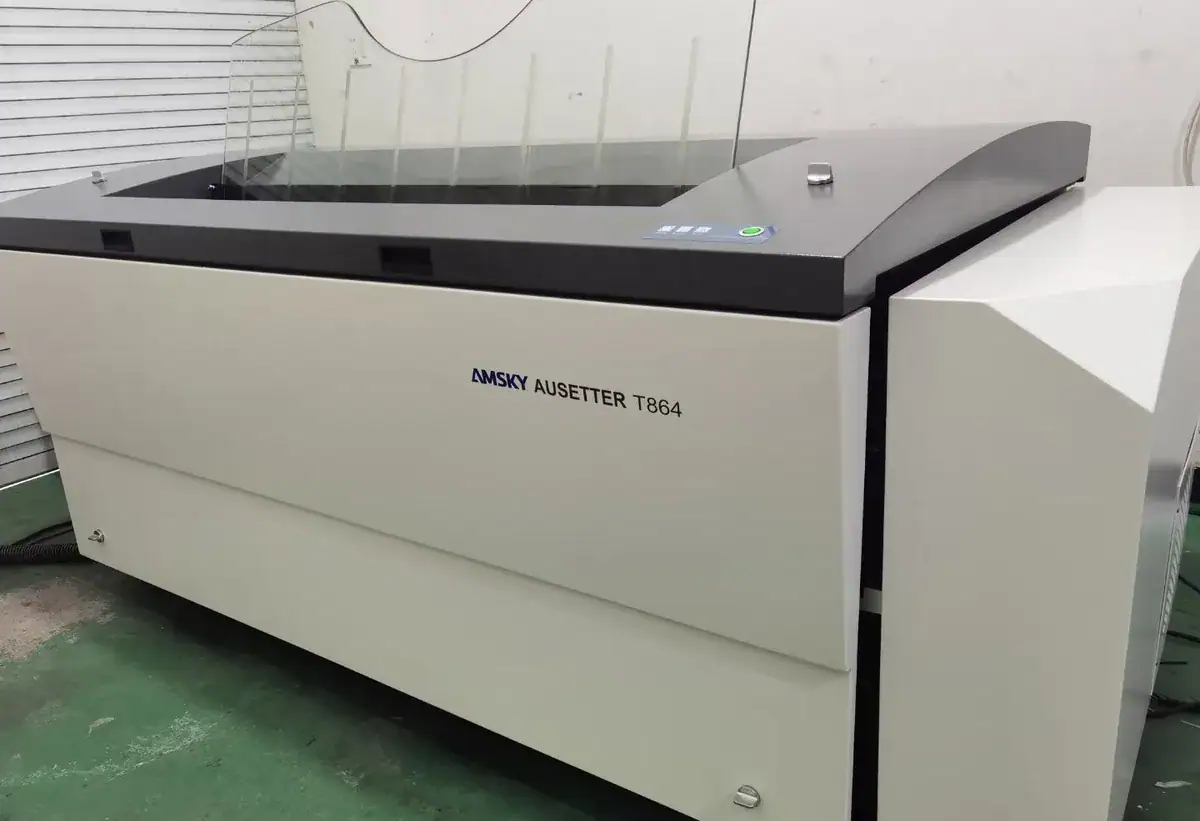
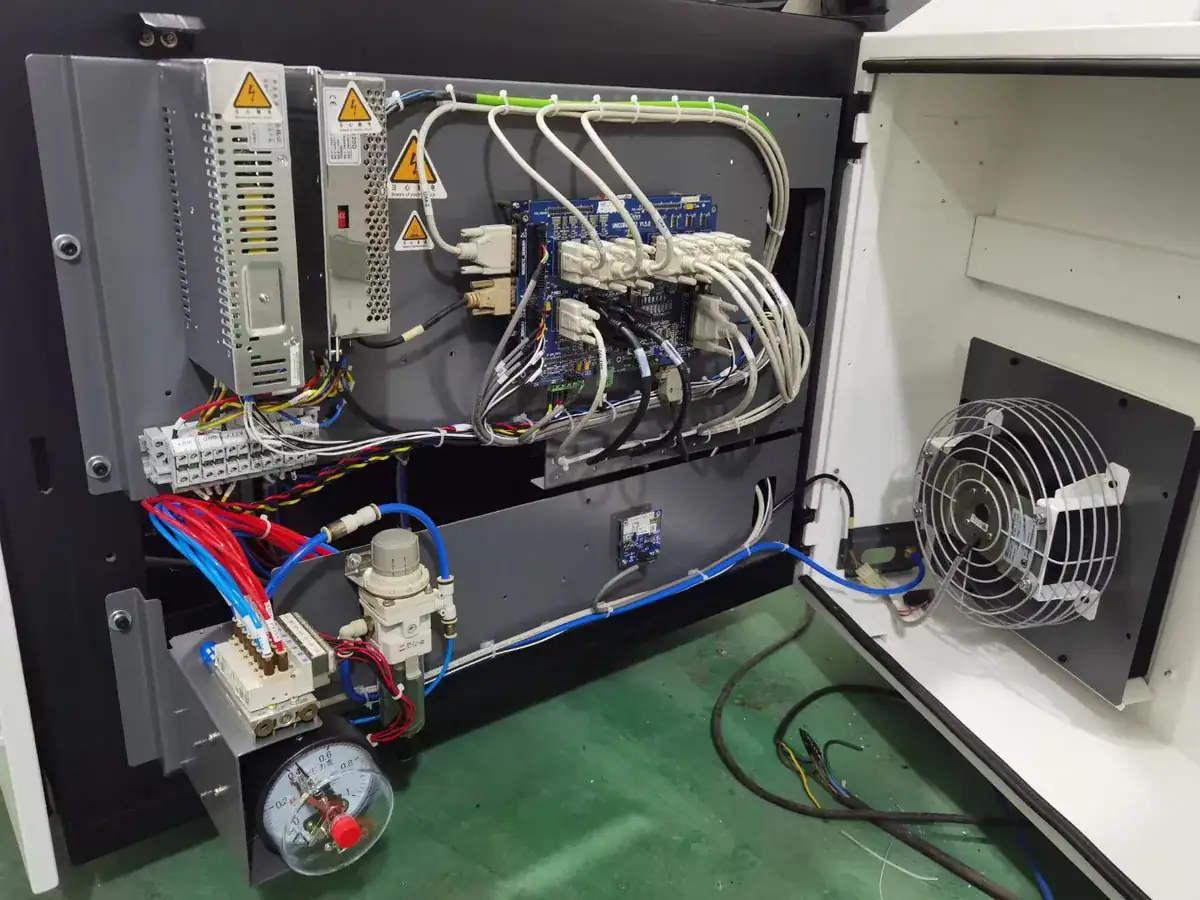
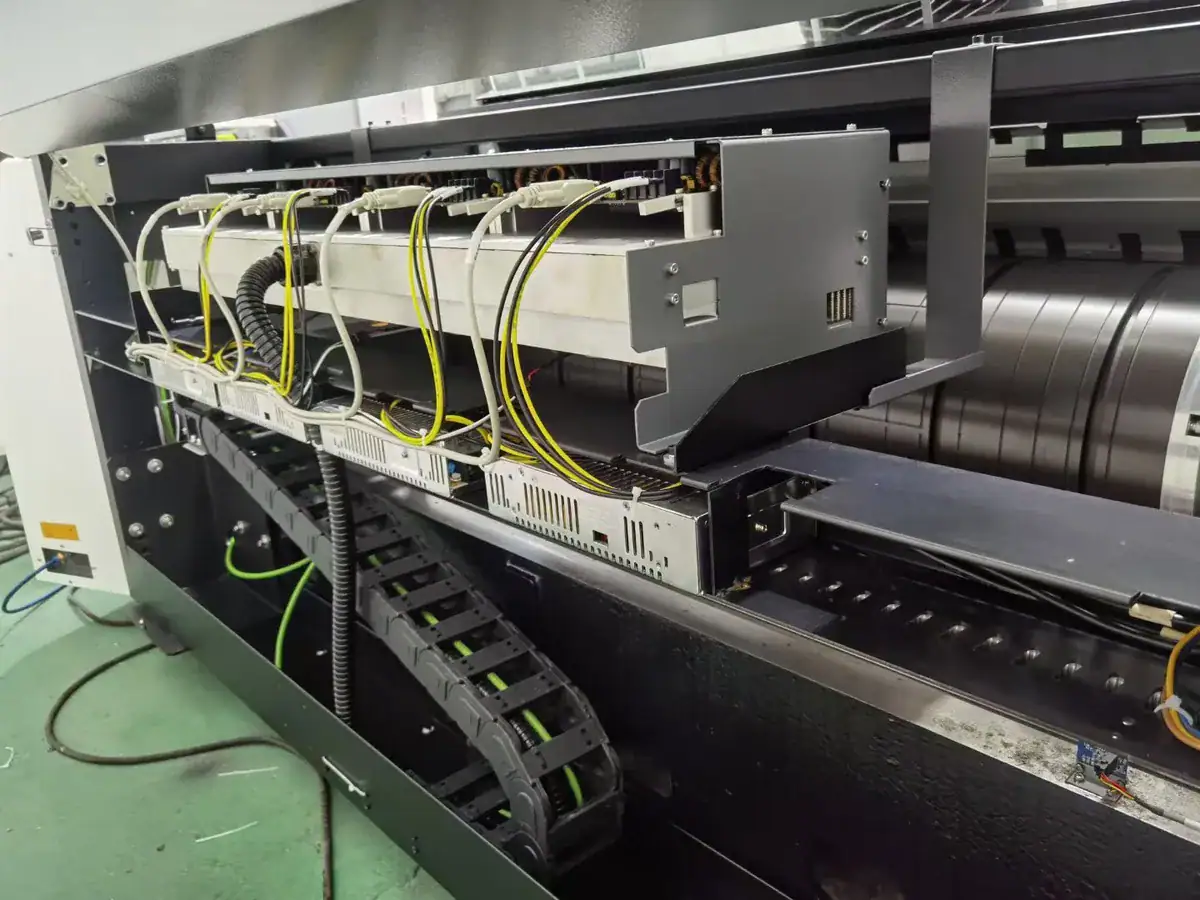
“Refurbished” should still mean something specific, so ask us what was done on the machine you are offered, just as you would ask any other seller.
Where our used machines are running
The hardest question in a used purchase is who answers when the machine stops. Here is how we have handled it on the used machines we have supplied in three African markets, 8 units in total.
| Market | Buyer | Used machines | On-site work we arranged |
|---|---|---|---|
| Ghana | End customer | 2 | Installation, commissioning and operator training |
| Nigeria | Dealer, reselling to its own customers | 5 | Installation, commissioning and operator training |
| Uganda | End customer | 1 | Installation, commissioning and operator training |
The support works in three layers:
- On-site installation. We arrange an engineer to visit the customer’s site to install and commission the machine.
- Local operator training. The engineer trains the customer’s local workers to run the machine.
- Two lines of after-sales support. If a problem arises, a local engineer goes to the site as the first response, and our engineers in China provide remote assistance promptly.
Ask any used machine seller to describe the same three layers for your country, and to name the people involved. If you are comparing offers, our technical support page explains how we work with customers after delivery.
Customer feedback from Nigeria

Kentai Integrated Services Ltd, based in Abuja, tells us the machine is easy to use, its quality is very good and the service has been good as well. If you would like to hear from a user directly, ask us about a customer reference.
Red flags that should stop the deal
- The seller will not power up the machine or run your file.
- The machine is already dismantled, but the seller still charges a “tested” price.
- There is no serial number, invoice or service history.
- The payment account is a personal one, or it is in a different name or country from the seller.
- The photos appear elsewhere online under another seller’s name, or show a different serial plate.
- The price is far below comparable listings and comes with pressure to pay a deposit today.
- No one, including the manufacturer, can supply parts or service for the model in your region.
So a used platesetter is not a good deal simply because the listing price is low and the seller says it was running. It becomes a good deal once a live imaging test, verified ownership, a landed cost budget and a named installer are all in place before the final payment. If you can arrange those four things, you are buying a working machine at a lower price. If you cannot, keep looking.
FAQ
Where can I buy a used CTP machine?
The main sources are printers selling directly, used machinery dealers, manufacturers or authorised refurbishers, auctions and online brokers. Authorised sellers usually offer the most protection at the highest price, while auctions and marketplaces carry the most risk.
How do I test a used platesetter before buying?
Watch it image your own test form while it is still installed. Include a full-width 50% tint, a 1% to 99% step wedge, fine lines and register marks, run the smallest and largest plates, and export the laser and error reports.
Can I inspect a used CTP machine remotely?
Partly. Hire a local engineer or third-party inspector if you can. Otherwise use a live video call showing the serial plate and a dated page, have your file imaged during the call, and get the plates couriered to you for measuring.
Who installs a used platesetter after it is moved?
It depends on the seller. Many supply only the hardware, which leaves you to find a third-party engineer who knows the model, so name that person and agree the price before you buy. For the used machines we supply, we arrange an engineer to install, commission and train your operators on site.
Should I buy a used plate processor with the platesetter?
Only after testing it with plates and inspecting its rollers, brushes, pumps and tank. Developer causes steady wear on these parts, so pairing a used platesetter with a new processor is often a sensible alternative.
Do you sell used CTP machines?
Yes. If you need a used platesetter, we can supply a refurbished Amsky machine, thermal (T series) or UV (U series), in 4-up or 8-up format. The exterior looks brand new, and each machine is fully refurbished and tested before it leaves the factory. The 2-year warranty starts at installation and use, and includes the laser head. We have supplied them to customers in Ghana, Nigeria and Uganda, with on-site installation, commissioning and operator training, backed by local engineers and remote assistance from our engineers in China. We also offer new platesetters supplied with our partner factories.
Looking for a used machine, or comparing an offer? Request a quote with your imaging technology, plate sizes, daily volume and destination port, and we will tell you what we can supply, along with suitable plates and a processor. Or contact us.
Disclaimer: this guide is general buying information for reference only, not legal, customs or engineering advice. Requirements differ by machine and country, so confirm them with qualified local advisers and the machine’s manufacturer. Machine availability, price, warranty and support terms are subject to the quotation and order documents. Amsky and its model names belong to their owner.


