
Last updated: October 2026
Quick answer: Thermal CTP images heat-sensitive plates with an 830 nm infrared laser and allows normal room-light handling within TDS limits. Violet CTP images negative-working photopolymer plates with a violet laser diode and needs a yellow safelight, usually with preheat and prewash. For new investment most printers choose thermal; a working violet system stays productive with a stable plate supply.
Key takeaways
- Thermal plates offer the widest grade choice: single-layer, double-layer and processless.
- Violet photopolymer plates are negative-working and must stay under a yellow safelight until processed.
- A working violet platesetter is not something to scrap; keep it running and plan the move to thermal.
- We manufacture both thermal and violet photopolymer plates; violet and thermal platesetters are supplied with our partner factories.
Many newspaper and commercial printers bought violet CTP systems years ago and still run them every day. The message we hear is: “Our violet platesetter still works but plate supply is getting harder.” At the same time, new buyers ask whether violet is old technology, so why invest? This article compares thermal and violet CTP fairly: how each system images a plate, how it handles in the plate room, which grades exist and what drives cost. For the complete list of plate families, see our article on CTP plate types.
Thermal vs violet CTP: decision table
| Criterion | Thermal CTP | Violet CTP |
|---|---|---|
| Imaging source | Infrared laser, 830 nm | Violet laser diode (wavelength per the platesetter specification) |
| Plate coating | Heat-sensitive (positive single/double-layer, or processless) | Photopolymer with protective overcoat, negative-working |
| Room light handling | Normal room light within TDS limits | Yellow safelight until processing is complete |
| Processing steps | Develop, rinse, gum; none for processless | Preheat (on grades that need it), prewash, develop, rinse, gum |
| Grade choice | Single-layer, double-layer, processless | Photopolymer grades per TDS |
| UV inks | Double-layer grade; processless after trial | Check the grade TDS |
| Typical users | Commercial, packaging, UV printers, most new installations | Newspaper and commercial plants with installed violet systems |
How thermal CTP works
A thermal platesetter writes the image with an 830 nm infrared laser. The plate reacts to heat rather than visible light, so it can be handled under normal room light within the limits in the TDS. On positive single- and double-layer plates the exposed coating becomes soluble and is removed in a plate processor with CTP developer. Processless thermal plates skip the processor and develop on press.
Our thermal CTP plates are made in our own factory in 0.15, 0.20, 0.25 and 0.30 mm gauges. The double-layer grade is the one we recommend for UV inks and the longest baked runs; single-layer thermal plates can be baked but are not UV-ink resistant, even after baking.
How violet CTP works
A violet platesetter uses a violet laser diode to expose a photopolymer coating. The exposed polymer starts to cross-link, preheat completes the reaction on grades that need it, a prewash removes the protective overcoat, and the developer washes away the unexposed coating. Because the exposed area becomes the image, violet plates are negative-working.
The coating reacts to violet and blue light, so plates fog in the plate room if the safelight is wrong. Keep unexposed violet photopolymer plates under a yellow safelight from opening the box to the end of processing. Another common complaint is that preheat settings drift and dots change; preheat temperature and processor speed should be checked at the frequency the TDS specifies.
When to choose thermal CTP
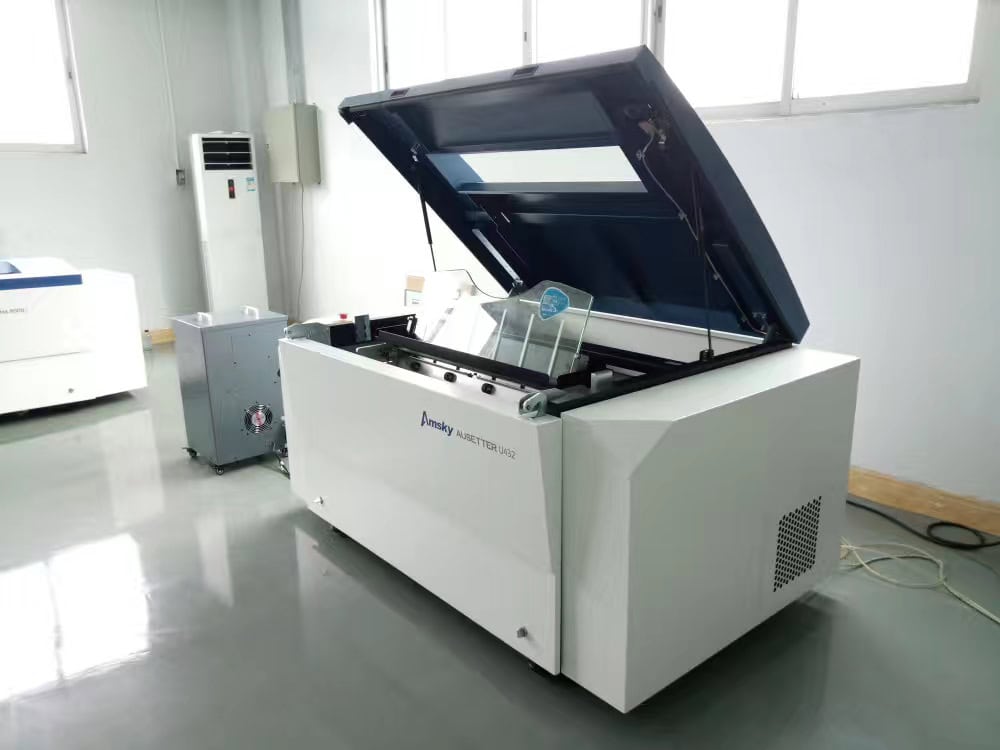
- You are buying a new platesetter. Thermal platesetters are supplied with our partner factories in several formats; compare them on our thermal platesetter page.
- You want daylight handling in the plate room and fewer handling errors.
- You run UV inks or very long runs and need a double-layer plate, with baking when required.
- You want the option to test processless plates and remove developer from the plate room.
When to keep or choose violet CTP
- Your violet platesetter is in good condition and not yet due for replacement.
- Your work is newspaper or commercial printing where violet plates already meet your run length and quality targets.
- You need a reliable second source of violet plates to protect price and delivery.
- You serve local printers as a bureau and your installed base is violet.
“Violet is old technology, so why invest?” is a fair objection to buying a new violet system. For an installed system, the better question is how to keep it productive. A stable violet plate supply lets you run it until a planned move to thermal. If you do need violet equipment, violet platesetters are supplied with our partner factories; see the violet CTP machine page.
Can you switch or run both?
A violet plate cannot be imaged on a thermal platesetter, and a thermal plate cannot be imaged on a violet platesetter. Switching therefore means a new platesetter, not just a new plate. The objection that switching to thermal means new everything is only partly true. A practical plan:
- Keep violet running on a stable plate supply while you budget for thermal.
- Install the thermal platesetter and calibrate it with its own curves.
- Review the processor. Violet lines include preheat and prewash; thermal plates need a plate processor set for CTP developer, or none for processless plates.
- Trial thermal plates on your press with your ink and paper.
- Move volume to thermal job by job, then retire violet when it no longer pays.
Plants that run both should keep violet plates and processing under safelight in a separate area and never mix developers between the two lines.
Cost and workflow factors
A common objection is that thermal plates cost more. Plate prices are confirmed in the quotation, and the plate price alone rarely decides the question. Compare these factors:
| Factor | Thermal CTP | Violet CTP |
|---|---|---|
| Plate | Single-layer, double-layer or processless | Photopolymer grade |
| Processing | Developer, rinse, gum (or none) | Preheat, prewash, developer, rinse, gum |
| Plate room | Normal room light within TDS limits | Yellow safelight |
| Equipment status | New or existing thermal platesetter | Usually an existing violet platesetter |
| Ink and run length | Grade choice covers conventional and UV inks | Per grade TDS |
| Supply security | Wide choice of plate sources | Fewer sources; second source recommended |
To compare the full cost of each line, use our plate cost calculator; for platesetter choices, the CTP machine selection guide helps you compare formats and automation.
FAQ
What is the difference between thermal and violet CTP?
Thermal CTP images heat-sensitive plates with an 830 nm infrared laser and allows room-light handling within TDS limits. Violet CTP images negative-working photopolymer plates with a violet laser diode and needs a yellow safelight, with preheat and prewash on most grades.
Is violet CTP obsolete?
Most new installations are thermal, but violet is not obsolete for plants that already run it. A working violet platesetter stays productive with a stable plate supply until a planned move to thermal.
Which is better for newspaper printing, thermal or violet?
Both are used in newspaper printing. Violet systems were widely installed in newspaper plants; for new investment, thermal gives daylight handling and more plate grades. Check run length and ink needs in the grade TDS.
Do violet plates need a safelight?
Yes. Violet photopolymer plates react to violet and blue light, so unexposed plates must stay under a yellow safelight until processing is complete.
Can I switch from violet to thermal CTP?
Yes, but it needs a thermal platesetter because violet and thermal plates are not interchangeable. Many plants run both during the transition and move volume to thermal job by job.
Are violet CTP plates cheaper than thermal plates?
It depends on grade, size and volume, and prices are confirmed in the quotation. Compare cost per usable plate, including processing steps, chemistry and remakes, not plate price alone.
Running violet today, or planning a move to thermal? Request a quote — send your platesetter type, plate size, gauge, monthly volume and ink type. Or request trial plates / contact us.
Disclaimer: values on this page are typical and for reference only; final specifications, MOQ, price and lead time are subject to the grade TDS and the quotation.


