CTP Machine Selection Guide
Last updated: October 2026
Quick answer: To choose a CTP machine, decide in this order: imaging technology (thermal, UV/CTcP or violet) to match the plates you want to run, format (4-up, 8-up or large format) to cover your largest press, automation level to match your shifts and volume, then check plate compatibility, the processing line and local service. Price comes last, once the configuration fits.
Key takeaways
- The imaging technology decides which plates you can run for the life of the machine; choose it first.
- Size the format to your largest press with sensible headroom, not to the biggest machine you can afford.
- Automation pays back with shifts and plate volume; a one-shift job shop rarely needs a fully automatic line.
- Installation, training and spare parts access matter as much as the machine itself.
- Platesetters we offer are supplied with our partner factories and matched with plates and processors from our own factory.
A platesetter is the most expensive item in most plate rooms and will shape your plate costs for many years. This guide walks through the decisions a printing house, packaging converter or prepress service bureau faces when buying a CTP machine. It focuses on the machine; for choosing the plate itself, see our printing plate selection guide.
A note on who makes what: we manufacture offset plates, plate processors, baking ovens, punches and benders in our own factory. The CTP platesetters we offer are supplied with our partner factories and configured and tested with our plates before shipping.
Start with your presses, plates and volume
Many buyers start from a price list and pick the fastest or cheapest machine on it. The right platesetter is the one that matches your plate type, press format, volume and service access; speed and price come after fit. Before you ask for quotations, collect:
- every press you run, with its plate size, gauge and punch pattern;
- the plate type you use today and the one you want to use in future;
- plates per day and per shift, and how many shifts you run;
- ink systems (conventional, UV, LED-UV) and typical run lengths;
- your current processor, developer and room conditions;
- the RIP or workflow software you already use.
Thermal, UV (CTcP) or violet: choosing the imaging technology
The light source of the machine decides which plates it can image. That choice outlives every other decision.
| Technology | Plates it runs | Best fit | Watch out for |
|---|---|---|---|
| Thermal platesetter (830 nm) | Single-layer, double-layer and processless thermal plates | New installations, commercial and packaging work, UV ink, long runs | Higher machine cost than CTcP at the same format |
| UV / CTcP machine | CTcP plates | Shops moving from film and PS plates that want to keep their UV plate workflow | Plates need a UV-safe light room; baking for UV ink |
| Violet platesetter | Violet photopolymer plates | Newspaper plants and existing violet workflows | Niche today; safelight handling |
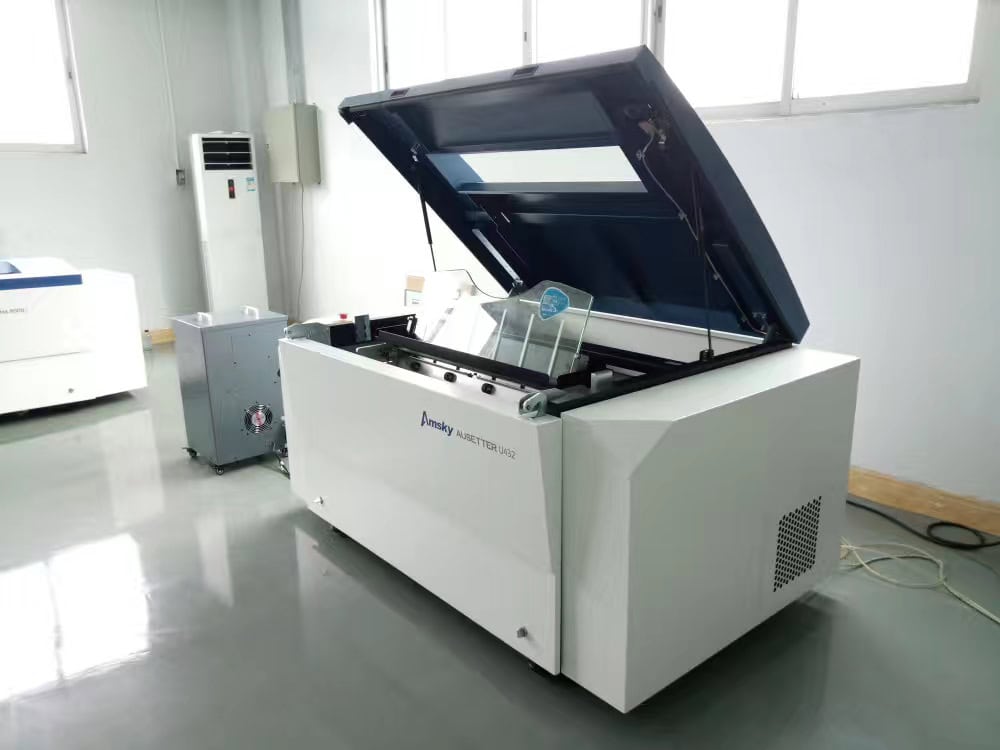
For most new commercial and packaging installations we recommend thermal: room-light handling, the widest plate choice and a clear path to processless plates. Thermal machines image any 830 nm thermal plate, so you are not locked into one plate brand. A CTcP machine is a sound, lower-cost choice when your team, chemistry and processor already run UV plates. Violet still fits newspaper plants that already run it.
Choosing the format: 4-up, 8-up or large format
The format tells you the largest plate the machine can image. Match it to your largest press and leave headroom for the next press you are likely to buy.
- 4-up: small and medium sheetfed presses, job shops and in-plant printers.
- 8-up: standard commercial sheetfed formats; the mainstream choice for commercial printers.
- Large format CTP machines: presses above 8-up in packaging, posters and books; plan the processor, oven and room for the same size.
Oversizing wastes money on drum, imaging head and floor space you will never use; undersizing locks out your biggest jobs. Check sizes against our plate size chart.
Automation level: manual, semi-automatic or fully automatic
| Level | What it does | Suits |
|---|---|---|
| Manual loading | Operator loads and unloads each plate | One shift, modest plate volume |
| Semi-automatic | Single-plate or cassette loading, inline to processor | Growing commercial printers |
| Fully automatic | Multi-cassette loading, slip-sheet removal, inline processor and stacker | Multi-shift plants and service bureaus |
If you feel you cannot afford full automation, you probably do not need it yet. Choose a machine that can be upgraded with an autoloader later, and put the budget into a stable processor. Throughput, laser configuration and resolution vary by model; read them in the machine specification sheet with its test conditions, not from a headline number.
Plate compatibility and the processing line
A platesetter is only half of plate making. Buyers who tell us “our plates did not image properly on the new machine” usually had a mismatch in exposure settings, developer or processor rather than a bad machine. Check:
- the plate family matches the light source;
- the plate processor and developer match the plate family and the format;
- a baking oven, punch and bender are sized for the same plates;
- the RIP drives the machine and fits your workflow.
Our CTP plate compatibility matrix lists the four layers to check. When machine and plates come from one supplier, we test the configuration with our plates before shipping, so there is no blame between machine and plate suppliers.
Installation, service and spare parts
The most expensive machine is the one that stands still. We hear stories like “the machine arrived but nobody could install it” and “spare parts take weeks to arrive”. Before you sign, ask:
- Who installs and trains, and how is it arranged in your country?
- Which spare parts and consumables should you keep on site?
- How is remote diagnosis handled, and how fast are parts shipped?
- What does the warranty cover, and for how long?
Buying a cheaper machine from an unknown supplier is risky if these answers are vague. Local support when something stops is worth paying for. See our technical support and warranty and service pages for how we handle it.
Budget and total cost of ownership
Price depends on technology, format, automation, RIP, processor, freight and installation. Compare total cost of ownership over the life of the machine: plate cost per job, chemistry, energy, service and downtime. Our article on CTP machine price factors explains each item. Exact machine prices, lead time and installation terms are confirmed in the quotation.
CTP machine selection checklist
| Decision | Question to answer |
|---|---|
| Technology | Which plates will we run for the next several years? |
| Format | Does it cover our largest press, with headroom? |
| Automation | How many shifts and plates per day? |
| Compatibility | Do processor, developer, oven, punch and RIP match? |
| Service | Who installs, trains and ships spare parts? |
| Cost | What is the cost per plate over the machine’s life? |
Browse the full range of CTP machines we supply. Ideally, you end up with a machine that fits your presses and your plates, and one supplier for machine and plates.
FAQ
How do I choose a CTP machine?
Choose the imaging technology for the plates you want to run, size the format to your largest press, pick an automation level for your shifts and volume, then check plate compatibility, processing line, service and total cost.
Should I buy a thermal or UV CTP machine?
Thermal suits most new installations, UV ink and long runs, and handles plates in room light. A UV (CTcP) machine suits shops that already run UV plates and want to drop film at lower machine cost.
What size CTP machine do I need?
Match the format to your largest press plate: 4-up for small presses, 8-up for standard commercial sheetfed, large format for presses above 8-up. Leave headroom for your next press.
Is a fully automatic CTP machine worth it?
It pays back in multi-shift plants and service bureaus with high plate volume. One-shift job shops usually do better with manual or semi-automatic loading that can be upgraded later.
Is a violet CTP machine still a good choice?
Mainly for newspaper plants and printers with an existing violet workflow. For new commercial or packaging installations we usually recommend thermal.
How much does a CTP machine cost?
It depends on technology, format, automation, RIP, processor, freight and installation. We explain the price factors in our article and confirm the exact price in the quotation.
Planning a new platesetter? Request a quote with your press list, plate sizes, current plate type, plates per day, shifts and ink system. Or request trial plates / contact us.
Disclaimer: values on this page are typical and for reference only; final specifications, MOQ, price and lead time are subject to the grade TDS and the quotation.