
Prepress Solutions for Printing Companies
Last updated: October 2026
Quick answer: A printing company’s plate room needs a plate grade, a platesetter, a processor with developer, and finishing tools matched to its own presses. Choose the plate technology from your job mix and existing platesetter, size the equipment to your largest press, and buy plates and chemistry for one stable processing chain. We manufacture the plates and processing equipment; platesetters come from our partner factories.
Key takeaways
- Printing companies make plates for their own presses, so stability across shifts matters more than format flexibility.
- Thermal, CTcP and processless plates each fit a different situation; there is no single right answer.
- Size the platesetter and processor to your largest press, and plan punches and benders around your register systems.
- Run trial plates alongside production before switching, so you do not stop presses.
This page is for commercial and packaging printers who make plates in-house for their own presses. If you image plates for other printers, the setup is different; see prepress service bureau equipment. Here we focus on three decisions a printing company faces when it sets up or upgrades its plate room, and on typical configurations that work.
What a printing company’s plate room looks like
In most printing companies, prepress serves a known, fixed press fleet. A commercial printer might run two or three sheetfed presses of different sizes; a packaging printer might run large-format presses for folding cartons. The plate room usually has one platesetter, one processor, a plate stock store, and in packaging plants a baking oven. Its job is simple to state and hard to do: deliver press-ready plates on time, every shift, with the same tone values.
The most common complaints we hear from printers are practical ones. Dot gain changes from one plate batch to the next. The night shift gets different results from the day shift. The company buys plates from three different suppliers and chemistry from a fourth, so when a problem appears, each one blames the other.
Decision 1: which plate technology fits your work
The plate technology should follow your job mix, the platesetter you own and your inks, not a trend.
- Thermal CTP plates imaged at 830 nm suit most commercial printing and packaging printing. A single-layer grade covers everyday work; a double-layer grade adds chemical resistance and can be baked for long runs or UV inks.
- CTcP plates are imaged with UV light and suit printers who already run a UV platesetter or want lower-cost plates for general commercial work.
- Processless plates remove the processor and developer, useful for printers short of space, water or skilled operators. They need a thermal platesetter and suit shorter runs; check the grade TDS for your work.
- Positive PS plates remain an option for printers still exposing film.
If you are comparing them in detail, our plate selection guide walks through each grade.
Decision 2: sizing equipment to your press fleet
A platesetter must image your largest plate, while the processor must accept the full plate width. Printers with mixed press sizes should list every press with its plate size, gauge (0.15, 0.20, 0.25 or 0.30 mm) and register system before choosing equipment. A platesetter that fits all your presses saves buying a second one later. Platesetters for thermal, UV CTcP and violet plates are supplied with our partner factories; see our CTP machine selection guide.
Finishing equipment follows the presses too. If your presses use pin register, a plate punch set to that pattern removes manual fitting. For presses with bent-edge plate clamps, a plate bender gives repeatable bends. Ours are pneumatic, so you need compressed air in the plate room.
Decision 3: keeping plates consistent across shifts
Plates that run the same every week come from a stable processing chain, not from the plate alone. Three habits make the difference:
- Use the developer designed for the plate, at the temperature and speed in the TDS, with regular replenishment. Our plate processors and CTP developer are set up for our plates.
- Check a control strip on the first plate of each shift and record the results.
- Store plate stock flat, dry and away from light and heat, following our plate storage guide.
Many printers worry that switching plates means re-calibrating curves. Some adjustment is normal with any new plate. We help with a test plan so you can run trial plates alongside production rather than stopping presses.
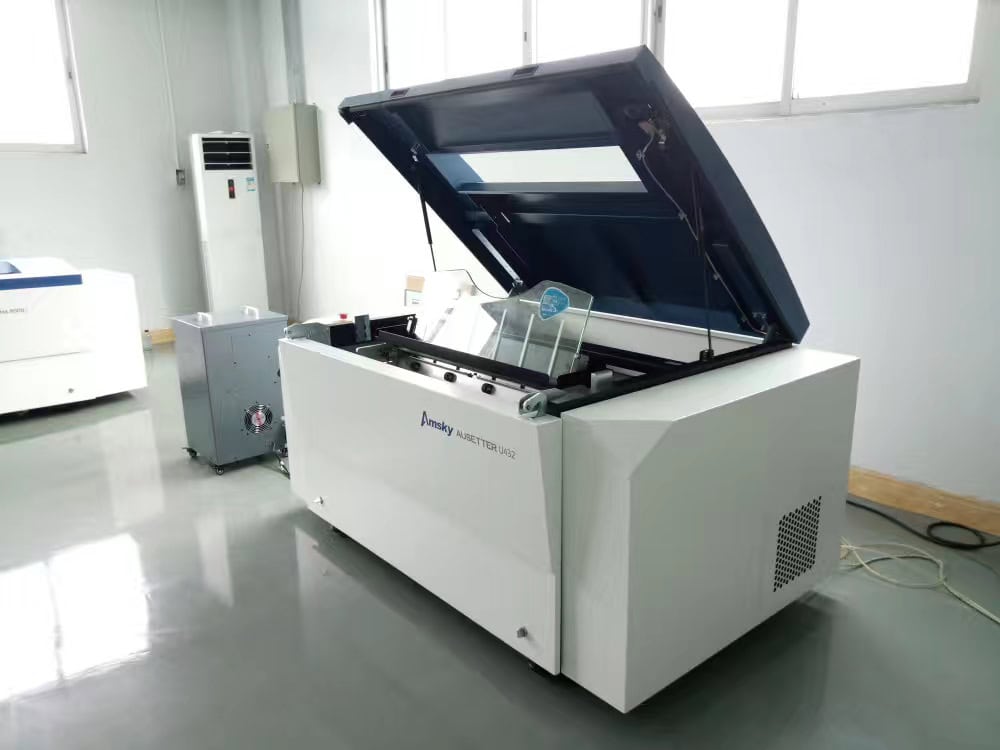
Typical prepress configurations for printing companies
| Printing company profile | Plates | Imaging (partner-supplied) | Processing and finishing (our make) |
|---|---|---|---|
| Commercial printer, mixed sheetfed presses | Single-layer thermal plate | Thermal platesetter covering the largest press | Processor, developer, punch for pin-register presses |
| Commercial printer with a UV platesetter | Single-layer CTcP plate | Existing UV CTcP platesetter | CTcP processor and developer |
| Packaging printer, folding cartons, UV or long runs | Double-layer thermal plate | Large-format thermal platesetter | Processor, baking oven, punch and bender |
| Small printer with limited space or water | Processless thermal plate | Thermal platesetter | No processor; plate punch if needed |
| Printer still using film | Positive PS plate, moving to CTP later | None yet | PS processor and developer |
These are starting points. We adjust them to your press list and work. For specific print processes, our printing applications pages go deeper, for example folding carton printing.
How we support printing companies
- Trial plates cut to your press size, so you can test on your own press. Sample terms are confirmed in the quotation.
- Technical support for processor setup, developer settings and troubleshooting.
- One supplier for plates and chemistry, so there is one contact when something goes wrong.
- OEM and private-label plates for printer groups that buy under their own brand, see OEM printing plates.
We are a plate manufacturer, and the plates, processors, baking ovens, punches, benders and developer come from our own factory. Platesetters, plate gum, baking gum and plate cleaner are supplied with our partner factories, and we say so on every quotation.
FAQ
What prepress equipment does a printing company need?
Usually a CTP platesetter, a plate processor with developer, and plate gum. Packaging printers often add a baking oven, and printers with pin-register or bent-edge clamps add a plate punch and plate bender. Processless plates remove the processor.
Should a printing company choose thermal, CTcP or processless plates?
Choose thermal plates for broad commercial and packaging work, CTcP plates if you run a UV platesetter, and processless plates if space, water or operator time is short. Your job mix, existing platesetter and ink system decide; we can review them with you.
How much plate stock should a printer keep?
Keep enough plate stock to cover your order lead time plus a safety margin, rotated first in, first out. The exact quantity depends on your consumption and shipping time; lead time is confirmed in the quotation, and storage conditions are in our plate storage guide.
Can I use your plates on my existing platesetter?
In most cases yes, as long as the plate type matches the platesetter: thermal plates on a thermal 830 nm platesetter, CTcP plates on a UV platesetter. Send us the platesetter type and plate sizes and we confirm compatibility before a trial.
Is it worth bringing plate making in-house?
It is often worth it when you have steady plate volume and want control over turnaround. Compare the equipment, chemistry and operator cost with what you pay an outside plate maker, and include the value of faster remakes.
Do you offer OEM or private-label plates for printers?
Yes. Printer groups and dealers can order plates under their own brand and packaging. Terms and MOQ are confirmed in the quotation.
Setting up or upgrading your plate room? Request a quote — send your press list with plate sizes, your current platesetter and processor, and monthly plate use. Or request trial plates / contact us.
Disclaimer: values on this page are typical and for reference only; final specifications, MOQ, price and lead time are subject to the grade TDS and the quotation.

