
Plate Exposure Unit
Last updated: November 2026
Quick answer: A plate exposure unit, also called a printing-down frame, exposes PS plates through a film positive. A vacuum pulls the film tight against the plate, and a UV light source images it before the plate goes to the processor. We make two types in our own factory: a high-speed vacuum unit and a horizontal unit. Each comes with a 1030 × 800 mm or 1130 × 980 mm exposing area, twice vacuum and twice exposure.
Key takeaways
- An exposure unit makes PS plates from film; a CTP platesetter makes plates without film.
- Both our units use twice vacuum (pre-vacuum and enhanced vacuum) and twice exposure for tight film contact.
- Exposing areas are 1030 × 800 mm and 1130 × 980 mm, with a 3 kW or 5 kW constant light source.
- Both need a 380 V three-phase, 25 A supply and a yellow-light room for PS plates.
- Price, lead time and configuration are confirmed in the quotation; special sizes can be ordered.
Plate rooms that still run film usually call us for one of three reasons: air bubbles under the film blur the dots, exposure changes as the lamp ages, or the old frame leaks vacuum. A new exposure unit fixes all three. This page explains what a plate exposure unit does, compares our vacuum and horizontal models, lists their specifications and shows how they fit a PS plate line. We also make the positive PS plates and the plate processors that go with them.
What is a plate exposure unit?
A plate exposure unit, also called a printing-down frame or offset plate making machine, transfers the image from a film positive onto a presensitised (PS) plate. The film is laid emulsion-down on the plate, a rubber blanket and glass frame close over both, and a vacuum pump removes the air so the film lies tight against the coating. A UV light source then exposes the plate. On a positive PS plate, the exposed coating becomes soluble and is removed in the developer, leaving the image under the film’s opaque areas.
The two things that decide plate quality are contact and dose. Poor vacuum contact lets light spread under the film, so small dots grow or disappear. An uneven or drifting light dose makes one plate print differently from the next.
Vacuum and horizontal exposure units
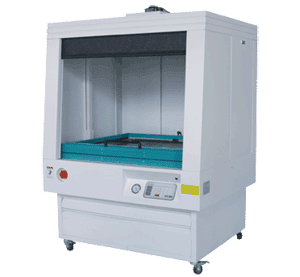
High-speed vacuum exposure unit (EPIII series). Built for plate rooms that expose many plates a day:
- LCD operating system with three operating modes.
- Double vacuum pumps and a double-loop, high-speed vacuum system for fast, even contact.
- Reflectors and a constant light source of 3 kW or 5 kW.
- A specially made sealed blanket that resists air leakage and ageing.
- Twice vacuum and re-exposure for even exposure across the plate.
- A fully closed structure with automatic shading.
- A double-frame design; the frame can be moved to the make-up room separately.
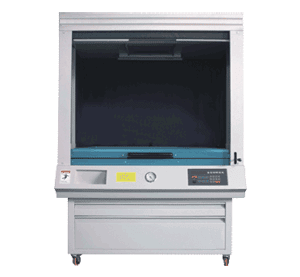
Horizontal exposure unit (EPI series). A simpler unit for smaller plate rooms:
- Microcomputer control with several dedicated channels.
- Twice vacuum and re-exposure.
- Constant light source with a shutter.
- A light integrator that calculates the required exposure automatically.
- A convenient shading system and a double-frame design.
Both types can be built to special sizes or configurations on request.
Exposure unit specifications
High-speed vacuum exposure unit
| Specification | EPIII-1150 | EPIII-1250 |
|---|---|---|
| Exposing area | 1030 × 800 mm | 1130 × 980 mm |
| Light source | 3 kW or 5 kW, constant | 3 kW or 5 kW, constant |
| Vacuum | Twice vacuum (pre-vacuum and enhanced vacuum) | Twice vacuum (pre-vacuum and enhanced vacuum) |
| Exposure | Twice exposure (pre-exposure and enhanced exposure) | Twice exposure (pre-exposure and enhanced exposure) |
| Power supply | 380 V, 3-phase, 50/60 Hz, 25 A | 380 V, 3-phase, 50/60 Hz, 25 A |
| Net weight | 420 kg | 486 kg |
| Dimensions | 1450 × 1260 × 2160 mm | 1640 × 1500 × 2280 mm |
Horizontal exposure unit
| Specification | EPI-1150 | EPI-1250 |
|---|---|---|
| Exposing area | 1030 × 800 mm | 1130 × 980 mm |
| Light source | 3 kW or 5 kW, constant | 3 kW or 5 kW, constant |
| Vacuum | Twice vacuum (pre-vacuum and enhanced vacuum) | Twice vacuum (pre-vacuum and enhanced vacuum) |
| Exposure | Twice exposure (pre-exposure and enhanced exposure) | Twice exposure (pre-exposure and enhanced exposure) |
| Power supply | 380 V, 3-phase, 50/60 Hz, 25 A | 380 V, 3-phase, 50/60 Hz, 25 A |
| Net weight | 320 kg | 385 kg |
| Dimensions | 1450 × 1260 × 2160 mm | 1640 × 1500 × 2280 mm |
Choose the model by the largest plate you expose: the 1150 models take plates up to a 1030 × 800 mm image area, the 1250 models up to 1130 × 980 mm. Our plate size chart lists common press formats.
How plate exposure works
- Prepare. Work in a yellow-light room. Clean the glass and blanket, then lay the PS plate coating-up.
- Place the film. Lay the film positive emulsion-down on the plate and fix it with register pins or tape.
- Pre-vacuum. Close the frame and run the pre-vacuum to draw the film onto the plate.
- Enhanced vacuum and exposure. The enhanced vacuum removes the remaining air, then the exposure runs. The second exposure step evens out the dose.
- Develop. Process the plate in a PS processor with positive PS developer. Our PS plate data sheet gives 22 to 25 °C for 20 to 40 seconds.
Set the exposure time with a grey scale on the plate. Our positive PS plate is correctly exposed when grey scale steps 3 to 4 are fully clear, depending on your exposure conditions. Check the grey scale again whenever you change the lamp, because exposure changes as the lamp ages.
For the full routine, from film contact and twice vacuum to setting the time with a grey scale and fixing common faults, read how to expose PS plates in a vacuum exposure unit.
Checking an exposure unit and the exposure
An exposure unit is only as good as its light and its vacuum. These are the values commonly specified for a printing-down frame; check them at installation and whenever plates start to vary.
| Check | Commonly specified value | Why it matters |
|---|---|---|
| Uniformity of illumination over the exposing area | ≥ 88% | Uneven light exposes the edges and centre of a large plate differently |
| Vacuum | Adjustable up to 650 mmHg, reaching 600 mmHg within 60 seconds | Poor film contact gives soft, enlarged highlight dots |
| Power supply | Works normally with ±10% voltage variation | Lamp output, and so exposure, drifts with the mains |
| Light shield | Fitted | Stray light fogs plates waiting in the room |
Reading the exposure from the dot strip
Fix development first: over-development also shrinks dots, so set the developer temperature and time to the TDS before judging exposure. Then expose a test plate with a dot strip and check it with a 30× loupe:
- Correct: 2% dots clear and 98% tints open. A good plate correctly exposed and developed holds 1–99%.
- Under-exposed: 98% tints filled in, 2% dots oversized, fine lines thickened, shadows not cleared. Lengthen the exposure.
- Over-exposed: 2% dots and fine lines lost, 98% openings enlarged. Shorten the exposure.
Change exposure one grey scale step at a time and expose a new test plate after each change.
After exposure: four checks on a test plate
| Check | How | Typical requirement for a positive PS plate |
|---|---|---|
| Resolution | Line target, 30× loupe | Lines of 10 µm or finer resolved |
| Dot reproduction | Dot strip | 2–98% |
| Background density | Density of the non-image area, compared with an area where the coating has been removed with solvent | Difference ≤ 0.03 |
| Ink receptivity | Ink the plate with a pad, rinse, inspect | Image takes ink fully; non-image stays clean |
Several films on one plate. When a plate carries several films or taped-up pages, follow the main exposure with a short second exposure through a diffusion film (a polyester film matte on both sides) laid on the glass. It removes the marks that film edges, register lines and tape leave on the plate. Find the time by test.
For grain, coating and developer checks on the plate itself, see PS plate quality indicators; developer faults are covered in the same place.
Choosing and installing an exposure unit
- Plate size. The exposing area must cover your largest plate, with margin for the film edges.
- Daily volume. For many plates a day, the high-speed vacuum unit saves time on every cycle; for a few plates a day, the horizontal unit is enough.
- Power. Both units need a 380 V three-phase, 25 A supply. Tell us if your site uses a different voltage.
- Room. Install the unit in a yellow-light room, on a level floor that carries the unit’s weight, with space to open the frame.
- Light source. Choose 3 kW or 5 kW; a stronger lamp shortens exposure time.
Our machine installation checklist helps you prepare power, space and the room before delivery.
Exposure unit or CTP?
A common belief is that film exposure is outdated. For PS plate workflows, a well-sealed vacuum frame with controlled exposure still gives sharp, repeatable plates, and it can run beside CTP. Many plants keep an exposure unit for film jobs, proofs or a backup line while their main plates come from a platesetter. If you are planning to move away from film, compare the routes in our CTP vs PS plate guide, or keep your UV workflow with CTcP plates on a UV platesetter. “A new frame is not worth it while we plan to move to CTP” can be a fair point; tell us your timeline and plate volume and we will suggest the cheaper route.
For a quotation, send your largest plate size, plates per day, the plate type you expose and your site’s power supply. Price, lead time and configuration are confirmed in the quotation.
FAQ
What is a plate exposure unit?
It is a vacuum frame with a UV light source that exposes PS plates through a film positive. It is also called a printing-down frame or offset plate making machine.
What is the difference between a vacuum and a horizontal exposure unit?
Both use twice vacuum and twice exposure. Our high-speed vacuum unit adds double vacuum pumps, an LCD operating system and a fully closed structure for high volume; the horizontal unit is a simpler microcomputer-controlled unit with a light integrator.
What size of plate can the exposure unit expose?
The 1150 models have a 1030 × 800 mm exposing area and the 1250 models 1130 × 980 mm. Special sizes can be ordered.
What power supply does a plate exposure unit need?
Our exposure units run on 380 V, 3-phase, 50/60 Hz, 25 A, with a 3 kW or 5 kW light source.
Do I still need an exposure unit if I use CTP?
Not for CTP plates, which are imaged by the platesetter. Many plants keep one for film jobs or as a backup line for PS plates.
Planning a PS plate line? Request a quote or contact us.
Disclaimer: specifications are typical values for reference only. Final specifications, price and lead time are confirmed in the quotation.

