
Last updated: November 2026
Quick answer: To expose a PS plate, lay a film positive emulsion-down on the plate in a vacuum exposure unit, draw a vacuum so the film lies tight against the coating, then expose with UV light. Set the time with a grey scale: our positive PS plate is right when steps 3 to 4 are fully clear. Develop in positive PS developer at 22 to 25 °C for 20 to 40 seconds.
Key takeaways
- Good vacuum contact and the right UV dose decide PS plate quality.
- Work in a yellow-light room from unpacking to development.
- Use a grey scale to set exposure, and check it again after every lamp change.
- Twice vacuum and twice exposure reduce trapped air and uneven dose.
- Most exposure faults are contact, dust or dose problems, not plate faults.
Plate rooms that still run film usually ask us about the same three problems: air bubbles under the film blur the dots, exposure changes as the lamp ages, and dust leaves pinholes or spots. Each has a clear cause and a routine that prevents it. What they want is sharp, repeatable plates from the film they already have. This guide walks through exposing positive PS plates in a vacuum exposure unit, step by step, with the settings that matter and a fault table at the end.
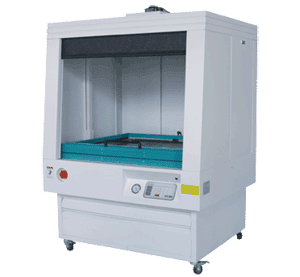
What a vacuum exposure unit does
A vacuum exposure unit, also called a printing down frame or offset plate making machine, holds the film and plate together under glass, removes the air with a vacuum pump and exposes them with a UV light source. On a positive PS plate, light makes the exposed coating soluble in the developer. The coating under the film’s opaque areas stays and becomes the printing image.
Two things decide the result: contact and dose. If air stays between film and plate, light spreads under the film edges, and dots grow, soften or vanish. If the dose is too low, the background does not clear; too high, and fine highlights burn out.
Before you expose: room and materials
- Light. PS plates are handled in a yellow-light room until they are developed.
- Clean glass and blanket. Dust on the glass or film prints as spots or pinholes.
- Film. Use a film positive with dense blacks and clean clear areas; the emulsion side faces the plate.
- Plates. Let plates reach room temperature in their packing before opening, and store them flat. Our PS plate data sheet gives the storage conditions.
Step by step: exposing a PS plate
- Place the plate coating-up on the blanket, square to the frame.
- Lay the film emulsion-down on the plate, in register with your pins or marks.
- Close the frame and pre-vacuum. The first vacuum stage draws the film onto the plate and pushes out most of the air.
- Enhanced vacuum. The second stage removes the air that remains, so the film lies flat over the whole plate.
- Expose. Run the exposure. On a unit with twice exposure, the second stage evens out the dose across the plate.
- Develop. Process the plate in positive PS developer at 22 to 25 °C for 20 to 40 seconds, then rinse, gum and dry in a plate processor.
Setting the exposure with a grey scale
Exposure time depends on the lamp, its age and the distance to the plate, so set it on your own unit. Place a grey scale on the plate beside the image, expose, develop and read the result. Our positive PS plate is correctly exposed when grey scale steps 3 to 4 are fully clear, depending on your exposure conditions. The dose for PS plates typically falls between 80 and 180 mJ/cm², depending on the lamp, and the plate is sensitive from 360 to 450 nm.
| Grey scale result | Meaning | Action |
|---|---|---|
| Fewer steps clear than the target | Under-exposed | Increase the exposure time |
| Steps 3 to 4 fully clear | Correct for our positive PS plate | Keep the setting and log it |
| More steps clear than the target | Over-exposed | Reduce the exposure time |
Lamps lose output with age, so exposure changes slowly over months. Repeat the grey scale check after any lamp change and on a fixed schedule. A unit with a light integrator, such as our horizontal exposure unit, measures the light received and adjusts the exposure automatically.
Common PS plate exposure faults
| Fault | Likely cause | Fix |
|---|---|---|
| Halo or soft dots around images | Poor vacuum contact; air under the film | Check the blanket seal; allow full pre-vacuum and enhanced vacuum |
| Small dots missing | Over-exposure or poor contact | Reduce exposure; check vacuum |
| Background tint after developing | Under-exposure or tired developer | Check the grey scale; check developer temperature and replenishment |
| Spots or pinholes | Dust on glass, film or plate | Clean the glass and film; keep the room clean |
| Exposure varies across the plate | Uneven lamp output or reflector problem | Use twice exposure; service the lamp |
A common belief is that film exposure is outdated. For PS plate workflows, a well-sealed vacuum frame with controlled exposure still gives sharp, repeatable plates, and it can run beside CTP. If you are weighing a move away from film, our CTP vs PS plate guide compares the routes. For CTP plates, exposure is set on the platesetter instead; see our CTP plate exposure test.
Choosing an exposure unit
Match the exposing area to your largest plate and the unit type to your volume. Our plate exposure units come in a high-speed vacuum version and a horizontal version, each with a 1030 × 800 mm or 1130 × 980 mm exposing area, a 3 kW or 5 kW constant light source, twice vacuum and twice exposure, on a 380 V three-phase supply.
FAQ
How do you expose a PS plate?
Lay a film positive emulsion-down on the plate in a vacuum exposure unit, draw a vacuum so the film lies tight against the coating, expose with UV light, then develop the plate in a PS processor.
How long should a PS plate be exposed?
Set the time with a grey scale. Our positive PS plate is correctly exposed when grey scale steps 3 to 4 are fully clear, depending on your lamp and conditions. The dose for PS plates is typically 80 to 180 mJ/cm² depending on the lamp.
Why do PS plates show halos or soft dots?
Usually poor vacuum contact: air trapped between film and plate lets light spread under the film. Check the blanket seal, vacuum time and film cleanliness.
What safelight do PS plates need?
Handle PS plates in a yellow-light room until they are developed.
Is a vacuum exposure unit the same as a printing down frame?
Yes. Printing down frame, vacuum frame, plate exposure unit and offset plate making machine all describe the same type of equipment.
Disclaimer: specifications are typical values for reference only. Final specifications, price and lead time are confirmed in the quotation.


