
Last updated: November 2026
Quick answer: Plate baking ovens come in three types. Vertical ovens hang plates on a trolley, drawer ovens hold plates flat in pull-out trays, and rotary ovens carry plates through on a conveyor. Choose by plate size and workflow: vertical or drawer for batches, rotary for continuous flow straight from the processor. All three bake our plates at the 230 to 250 °C, 5 to 8 minute recipe in the plate data sheet.
Key takeaways
- Batch ovens (vertical and drawer) suit plants that bake plates for selected long jobs.
- Rotary ovens suit high volume, with plates fed straight from the processor.
- Maximum plate size and plates per shift decide the model.
- The plate data sheet, not the oven, sets temperature and time.
- All our ovens need a 380 V supply; check power and floor space first.
Plant managers usually start this comparison for one of two reasons: plates wear out before long jobs finish, or an old oven bakes unevenly and plates come out warped. Both point to the same decision: which oven type fits the way plates move through your plate room. This article compares vertical, drawer and rotary plate baking machines on loading, capacity, footprint and power, with the specifications of the ovens we make.
Why plates are baked
Baking hardens the image coating after development, so the plate lasts longer and resists wear and press chemicals. On our data sheets, baking takes the single-layer thermal plate from at least 50,000 to at least 150,000 impressions, the CTcP plate from at least 50,000 to at least 150,000 and the positive PS plate from at least 80,000 to at least 200,000. Our printing plate baking guide covers gumming, the baking routine and faults.
The three oven types at a glance
| Point | Vertical oven | Drawer oven | Rotary oven |
|---|---|---|---|
| How plates are loaded | Hung on a handling trolley that rolls into the chamber | Laid flat in pull-out trays | Fed onto a moving conveyor |
| Workflow | Batch | Batch | Continuous |
| Plates per cycle | Up to 16 (SBK vertical) | 8 to 16 (SBK880, SBK1600) | One after another |
| Maximum plate size | 1030 × 800 mm | Up to 1680 × 1400 mm | Up to 1120 mm wide |
| Temperature | 20 to 250 °C | 210 to 260 °C | 230 to 280 °C |
| Power | 8 kW | 15.8 or 18 kW | 7.5 to 11.5 kW |
| Best for | Batches of sheetfed plates | Batches, including large formats | High plate volume |
Vertical ovens
In a vertical oven, plates hang on a handling trolley outside the oven, then the trolley rolls into the chamber. Operators load and unload away from the hot chamber, and plates hang without touching each other. Our vertical oven takes up to 16 plates of 1030 × 800 mm, controls temperature from 20 to 250 °C, runs on 380 V at 8 kW and weighs 320 kg. It suits sheetfed plants that bake a batch of plates for a long job.
Drawer ovens
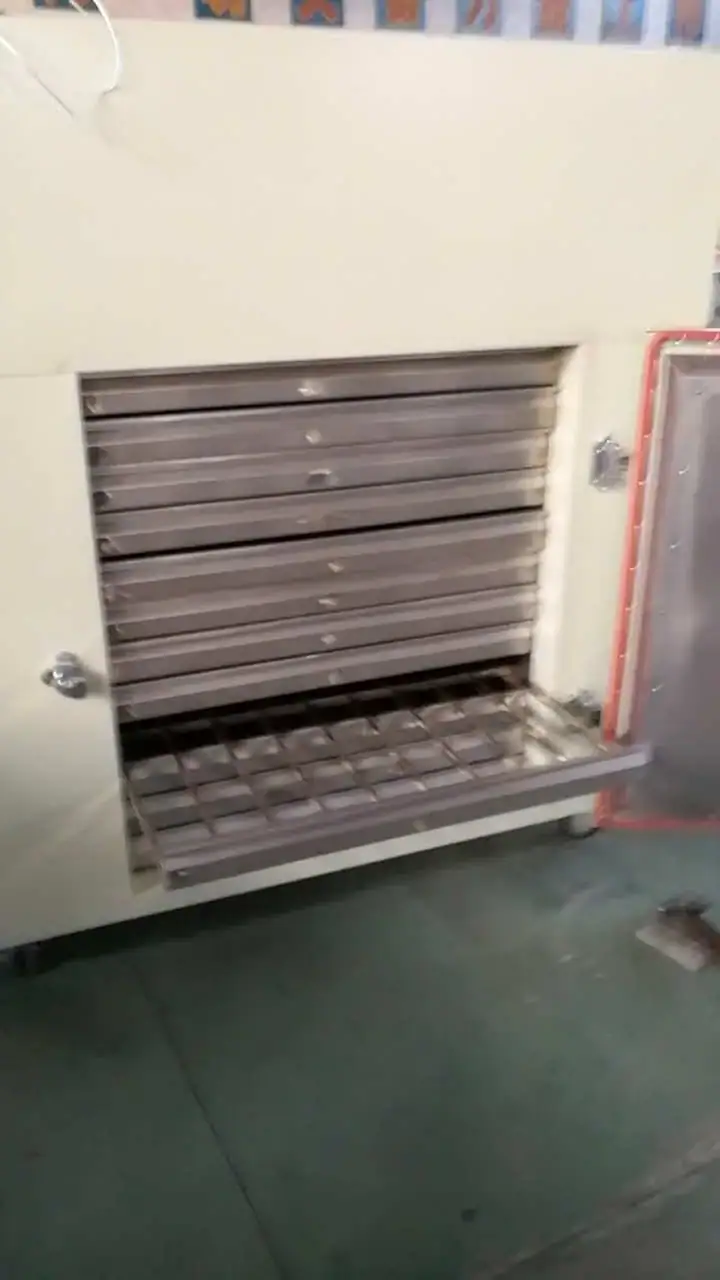
A drawer oven holds plates flat in pull-out trays inside one insulated chamber, with hot air circulated through every drawer so top and bottom plates bake alike. Our SBK880 takes plates up to 800 × 1050 mm and our SBK1600 up to 1680 × 1400 mm, 8 to 16 plates per cycle, at 210 to 260 °C, drawing 15.8 kW and 18 kW. Drawer ovens are the choice when you bake batches of large-format plates.
Rotary ovens
A rotary oven carries plates through on a conveyor, so baking keeps pace with the processor. It uses infrared heating, and both the temperature and the conveyor speed are adjustable. Our models:
| Specification | EP800 | EP880 | EP1120 |
|---|---|---|---|
| Maximum baking width | 800 mm | 880 mm | 1120 mm |
| Working temperature | 230 to 280 °C | 230 to 280 °C | 230 to 280 °C |
| Baking time | 4 to 7 min | 4 to 7 min | 4 to 8 min |
| Power | 7.5 kW | 8.5 kW | 11.5 kW |
| Weight | 200 kg | 240 kg | 280 kg |
Rotary ovens make sense where many plates a shift need baking, because no one waits to fill a batch.
How to choose
| Your situation | Oven type |
|---|---|
| A few long jobs a day, sheetfed plates up to 1030 × 800 mm | Vertical oven |
| Batches that include plates larger than 1030 × 800 mm | Drawer oven (SBK1600 for up to 1680 × 1400 mm) |
| Most plates baked, high daily volume | Rotary oven |
| Plates up to 1120 mm wide in continuous flow | Rotary EP1120 |
Some buyers call baking an outdated extra step. In fact baking is a cheap way to multiply run length: on our single-layer thermal plate it triples the data-sheet figure. Others say “an oven takes too much space and power”. Compare the oven’s power and footprint with the plates it saves on long runs, and size the oven to the plates you actually bake, not to every plate you make.
Setting the bake
Whatever the oven, the plate grade decides the recipe. Our thermal, CTcP and PS data sheets give 230 to 250 °C for 5 to 8 minutes. Under-baking gives little benefit, and over-baking can stain the background and warp the plate. Processless plates should not be baked without checking with us first, violet photopolymer plates are not post-baked, and baking does not make a single-layer plate resistant to UV ink; for UV work, see our single-layer vs double-layer comparison.
FAQ
What types of plate baking ovens are there?
Three main types: vertical ovens where plates hang on a trolley, drawer ovens where plates lie flat in trays, and rotary ovens where plates move through on a conveyor.
Which baking oven is best for high volume?
A rotary oven, because plates go straight from the processor into the oven without batching. Drawer and vertical ovens suit batch work.
What temperature do you bake printing plates at?
Follow the plate data sheet. Our thermal, CTcP and PS plates bake at 230 to 250 °C for 5 to 8 minutes.
What power does a plate baking oven need?
Our baking ovens run on 380 V. Power ranges from 7.5 kW for the smallest rotary oven to 18 kW for the large drawer oven.
Can every plate be baked?
No. Processless plates are not baked without checking with us first, and violet photopolymer plates are not post-baked.
Disclaimer: specifications are typical values for reference only. Final specifications, price and lead time are confirmed in the quotation.


