
Last updated: November 2026
Quick answer: A platesetter is the computer-to-plate (CTP) machine that images printing plates directly from digital files, with no film. It receives screened 1-bit data from the RIP and exposes the plate coating with a thermal laser, a 400–410 nm (UV) laser or a violet laser. The imaging technology decides which plates you can use, so the platesetter and plate must always be chosen together.
Key takeaways
- A platesetter images plates directly from RIP data; an imagesetter outputs film.
- Thermal (830 nm), UV (CTcP) and violet machines each need matching plates.
- Format (2-up, 4-up, 8-up, large format) follows your largest press.
- Automation — autoloader, inline punch, bridge, stacker — follows volume and labour.
For printers still outputting film, the move to CTP starts with one question: what exactly is a platesetter, and which kind fits our work? Film output is slow and costly, but buyers are often unsure which platesetter type to buy and worried about service after installation. This guide explains how a platesetter works, the main types, drum designs, formats and automation, and what to check before you buy. For a broader introduction to the process, read what is CTP printing.
What is a platesetter?
A platesetter (also called a CTP machine or plate recorder) is the output device of a computer-to-plate workflow. It takes the screened job data from the RIP and transfers it directly onto the plate by exposing the plate’s imaging coating, point by point. After imaging, the plate goes to a processor (or straight to press, for processless plates).
Some buyers think a platesetter is just a printer for plates and any model works with any plate. In fact the platesetter’s imaging technology decides which plates you can use, so machine and plate must be chosen together.
How a platesetter works
- RIP output. The RIP converts the imposed PDF into 1-bit screened data (often 1-bit TIFF) with the correct calibration curve. See our CTP RIP workflow guide.
- Plate loading. The plate is loaded by hand or by an autoloader, positioned against register pins and held by clamps and vacuum.
- Imaging. The imaging head moves across the plate while the drum turns (or the plate moves on a flatbed). Each laser channel or light pixel switches on and off to expose the dots.
- Unloading. The imaged plate is released to the operator, a bridge into the processor, or a stacker.
- Processing. The plate is developed, rinsed and gummed in a CTP plate processor, then punched and bent for the press.
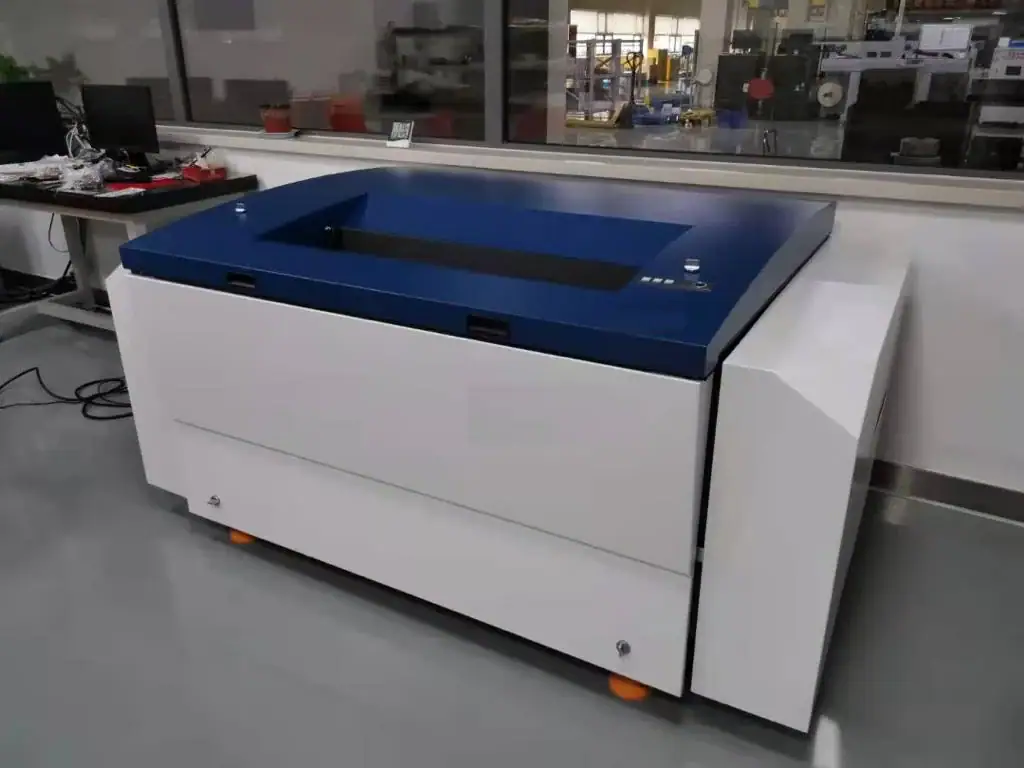
Types of platesetters by imaging technology
| Type | Light source | Plates it images | Typical handling |
|---|---|---|---|
| Thermal | 830 nm infrared laser diodes | Thermal single-/double-layer, processless | Daylight handling of plates |
| UV (CTcP) | 400–410 nm laser diodes | CTcP plates | Yellow safelight |
| Violet | Violet laser diode | Violet photopolymer plates | Yellow safelight |
Thermal is a widely used technology for commercial and packaging printing; UV platesetters image CTcP plates on aluminium similar to conventional PS plates; violet remains common in newspaper plate rooms. Our product pages describe each machine: thermal CTP machines, UV CTP machines and violet CTP machines.
Drum designs, formats and automation
Drum design. In the industry, thermal platesetters are typically external drum: the plate wraps around the outside of a rotating drum. Internal drum machines hold the plate inside a half-cylinder with a spinning mirror, and flatbed machines image the plate lying flat — designs often used for violet imaging. Each design has its own trade-offs in size, mechanics and plate handling.
Format. Platesetters are sized by how many A4 pages fit on the largest plate:
| Format | Fits presses of | Typical user |
|---|---|---|
| 2-up | Small offset | Quick printers, in-plants |
| 4-up | Half-size sheetfed | Commercial printers, label and carton shops |
| 8-up | B1 / full-size sheetfed, many web presses | Commercial, packaging, book and newspaper |
| Large format | Very large sheetfed presses | Packaging and poster printers |
Automation. Manual machines are loaded one plate at a time. Semi-automatic and fully automatic machines add an autoloader (removing interleaving paper), inline punch, a bridge or conveyor to the processor and a stacker. An 8-up platesetter is available fully automatic. Automation saves labour and handling damage at high volume. Our article on 4-up vs 8-up CTP helps decide the format.
A platesetter is only as good as the plates it produces: the output has to let the press reach the tone value increase aims in ISO 12647-2, with colour approved against proofs made to ISO 12647-7.
Platesetter vs imagesetter
An imagesetter outputs film, which is then contact-exposed onto PS plates in a vacuum frame. A platesetter skips film entirely. Removing film removes one generation of dot loss, film dust and register errors, plus film chemistry and the exposure frame. Imagesetters are now rare; most remaining film workflows run with positive PS plates. If you still expose PS plates through film, our positive PS plates continue to serve that workflow while you plan a move to CTP.
For a step-by-step comparison of the two workflows and when to switch, see CTP vs CTF: imagesetter or platesetter.
What to check before buying a platesetter
Platesetters are supplied with our partner factories, and we match them with plates, processors and chemistry from our own factory. Use this checklist:
| Check | Why it matters |
|---|---|
| Imaging technology | Decides your plate type and plate cost |
| Maximum and minimum plate size, gauge range | Must cover every press you run |
| Throughput, resolution, laser specification | See the machine specification sheet and its test conditions |
| Automation level | Labour, volume, plate handling damage |
| RIP and file connection | RIP normally included or optional; an existing RIP can drive it via 1-bit TIFF |
| Site and installation | Engineer on site, or remote video guidance and manuals; confirmed in the quotation |
| Spare parts and service | Laser and head service, parts availability |
A platesetter can seem too expensive for small volumes, so size the machine to your largest press and real plate volume. Buying one does not lock you into one plate supplier: any plate of the matching technology and format can be used after linearisation and a trial. The CTP machine selection guide covers the next steps.
FAQ
What is a platesetter?
A platesetter is a computer-to-plate machine that images printing plates directly from digital data, without film, using a thermal laser, a 400–410 nm (UV) laser or a violet laser.
How does a platesetter work?
It receives 1-bit screened data from the RIP, holds the plate on a drum or flatbed, and exposes the plate coating dot by dot with a laser. The plate is then processed, unless it is a processless plate.
What is the difference between a platesetter and an imagesetter?
An imagesetter outputs film that must be exposed onto PS plates; a platesetter images the plate directly, removing film, a contact exposure step and one source of dot loss and register errors.
What are the types of platesetters?
By technology they are thermal (830 nm), UV or CTcP, and violet platesetters. By design they are external drum, internal drum or flatbed, and they come in manual, semi-automatic and fully automatic versions.
What does a 4-up or 8-up platesetter mean?
It describes the largest plate the machine can image: a 4-up plate holds four A4 pages and suits half-size presses; an 8-up plate holds eight A4 pages and suits full-size sheetfed and many web presses.
Planning a platesetter and plate package? Request a quote — send your press sizes, plate type, monthly plate volume and preferred automation level. Or request trial plates / contact us.
Disclaimer: values on this page are typical and for reference only; final specifications, MOQ, price and lead time are subject to the grade TDS and the quotation.


