
Last updated: October 2026
Quick answer: Choose a 4-up CTP if every press you run, and the next press you plan to buy, is a small or half-size sheetfed press. Choose an 8-up platesetter if you run, or will soon run, full-size commercial presses. Format follows your largest plate size, not your budget alone, and it also sets the processor width, punch and floor space you need.
Key takeaways
- 4-up and 8-up describe the largest plate a platesetter can image, expressed as how many standard pages fit on the plate.
- Size the machine to your largest press today plus the press you realistically plan to add, not to the biggest machine on the price list.
- An 8-up machine images smaller plates too, but it costs more, takes more space and needs a wider processor.
- Platesetters we offer are supplied with our partner factories; plates, processors and punches come from our own factory.
Format is the first number every platesetter quotation starts with, and it is the one decision you cannot change after the machine is installed. Buyers often ask us whether they should “go big to be safe”. Sometimes that is right; often it means paying for capacity that sits idle while the processor, plate stock and floor space all grow with it. This post compares 4-up and 8-up CTP machines in practical terms. For the wider decision (imaging technology, automation and service), read our CTP machine selection guide.
4-up vs 8-up CTP at a glance
| Criterion | 4-up platesetter | 8-up platesetter |
|---|---|---|
| Typical press class | Small and half-size sheetfed presses | Full-size commercial sheetfed presses, plus all smaller presses |
| Pages per plate (industry convention) | Four standard pages | Eight standard pages |
| Machine investment | Lower | Higher |
| Floor space and installation | Compact footprint | Larger footprint, heavier crate |
| Processor needed | Narrower plate processor | Processor wide enough for the largest 8-up plate |
| Plate stock | Fewer, smaller sizes | More sizes to stock if you also run small presses |
| Best fit | Quick printers, job shops, label and small packaging lines | Commercial printers, magazine and catalog work, folding cartons |
| Imaging technologies offered | Thermal and UV (CTcP) | Thermal, UV (CTcP) and fully automatic configurations |
Exact maximum and minimum plate sizes, imaging speed and resolution differ by configuration; always check the machine specification sheet for the unit you are quoted.
What 4-up and 8-up mean
The terms come from imposition. A 4-up plate carries four standard pages on one side of the sheet; an 8-up plate carries eight. In everyday use the label describes the press class the platesetter can serve: 4-up machines cover small and half-size presses, while 8-up machines cover the full-size commercial presses that dominate catalog, magazine and carton work. The label is a press-format class, not a speed rating. Two 8-up machines can differ widely in throughput and automation.
Your plate size, not the label, is what matters. Before comparing machines, list the plate size, gauge (typically 0.15 mm, 0.20 mm, 0.25 mm or 0.30 mm) and punch pattern of every press. Our printing plate size chart helps you check common press formats.
When to choose a 4-up CTP machine
A 4-up platesetter is the sensible choice when all your presses are small or half-size, and when your growth plan is more volume on the same press class rather than a bigger press. Typical buyers are quick printers, job shops, label converters running offset, and printing houses adding a first CTP line to replace film.
- Your largest press fits comfortably inside the 4-up plate range on the specification sheet.
- You have no realistic plan to add a full-size press in the machine’s working life.
- Floor space in the plate room is tight.
- Plate volume is moderate and fits a single shift.
- You want a lower investment and a smaller processor.
The common pain we hear is “our largest press does not fit the machine”. It happens when a shop buys a 4-up machine and then adds a bigger press two years later. If that press is already in your plan, budget for 8-up now.
When to choose an 8-up CTP machine
An 8-up platesetter fits printers who run full-size commercial presses, or a mix of full-size and smaller presses that one machine must serve. It is also the usual choice for prepress service bureaus that make plates for many customers’ presses.
- You run at least one full-size press, or one is confirmed in your investment plan.
- You need one machine that covers all your presses, from small to large.
- Plate demand is high enough that plates waiting for the platesetter hold up the presses.
- You are considering a fully automatic line with plate loading for multi-shift work.
The honest objection is “an 8-up machine costs too much for our volume”. If you only run small presses and have no bigger press planned, that objection is correct. “We paid for a big machine that sits idle” is a regret we hear from buyers who sized up without a reason.
Can one platesetter serve both formats?
Yes, in one direction. An 8-up CTP machine can image smaller 4-up plates, within the minimum plate size on its specification sheet. A 4-up machine cannot image an 8-up plate. That is why buyers who want room to add a bigger press later often choose 8-up.
Running small plates on a large machine does have trade-offs. Imaging time per plate depends on the drum and the plate size, so small plates do not always gain much speed. You may also need two punch configurations and must stock more plate sizes. If you run very different volumes on small and large presses, some printers keep a 4-up machine for the small presses and add an 8-up machine for the large ones. Plate type also matters more than format: a thermal machine images thermal CTP plates at 830 nm, while a UV machine needs CTcP plates. Format and technology are separate choices.
Cost and workflow factors beyond the machine
Many buyers think format only affects the platesetter price. In practice, format also sets the processor width, plate stock, punch and floor space you need. Plan the whole line:
| Item | What changes with 8-up | What to check |
|---|---|---|
| Plate processor | Must accept the widest plate you image | Processor working width vs largest plate |
| Plate punch and bender | Dies and settings for each press model | Punch dies made per press model; bender set per press |
| Plate stock | More sizes if you run mixed presses | Storage space and order quantities per size |
| Room and power | Larger footprint and service access | Site plan, power supply, temperature and humidity |
| Freight and installation | Larger crate, more handling | Door width, forklift, unloading route |
| Cost per plate | Plate price rises with plate area | Mix of sizes per month |
We manufacture the CTP plate processors, baking ovens and the pneumatic plate punch machines that sit beside the platesetter. Our punches and benders run on compressed air, and punch dies can be custom-made for your press model, so matching them to the platesetter format is part of the quotation. Price drivers for the machine itself are explained in our CTP machine price guide; we do not publish figures because configuration changes them.
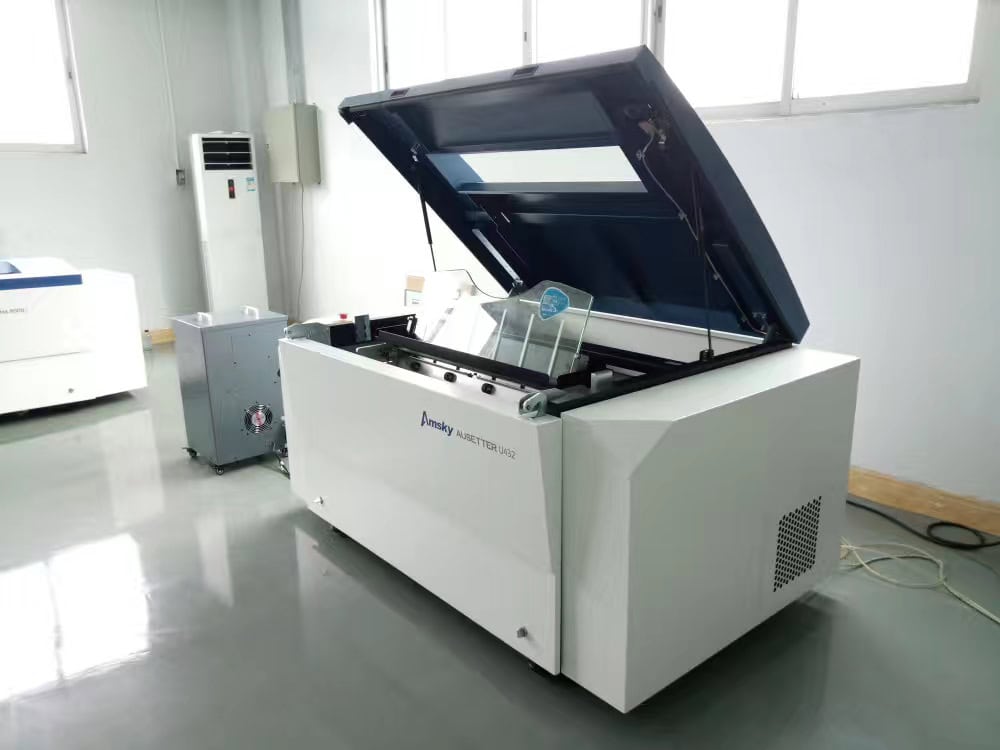
Buyer’s checklist before you ask for a quote
| Check | Why it matters |
|---|---|
| Plate size, gauge and punch of every press | Defines the minimum format you need |
| Presses planned for the next few years | Avoids buying a 4-up machine you outgrow |
| Plates per day and number of shifts | Decides manual vs automatic loading |
| Plate type: thermal, processless or CTcP | Decides thermal or UV imaging |
| Existing processor and chemistry | Shows whether the processor must be replaced |
| Room size, power and climate control | Confirms the site can take the machine |
| Local service and spare parts access | Downtime costs more than the format difference |
To reduce risk, ask for the machine specification sheet in writing, run trial plates on your own presses, and plan installation and acceptance tests before shipping. Our machine installation and acceptance checklist lists what to prepare on site.
FAQ
What is the difference between a 4-up and 8-up CTP?
The difference is the largest plate the machine can image. A 4-up CTP serves small and half-size presses; an 8-up CTP serves full-size commercial presses and can also image smaller plates within its minimum size.
What does 4-up and 8-up mean in printing?
They describe how many standard pages fit on one plate: four or eight. In CTP buying, the terms are used as press-format classes rather than exact plate sizes, so always check the specification sheet.
Can an 8-up CTP image 4-up plates?
Yes, an 8-up platesetter can image smaller plates down to the minimum size on its specification sheet. A 4-up machine cannot image 8-up plates.
Which presses need an 8-up platesetter?
Full-size commercial sheetfed presses used for catalogs, magazines and folding cartons need an 8-up machine. Small and half-size presses are covered by a 4-up machine.
Is an 8-up CTP machine worth the extra cost?
It is worth it if you run or will soon run a full-size press, or need one machine for all presses. If you only run small presses with no bigger press planned, a 4-up machine is usually the better investment.
Do you manufacture the platesetters?
No. Our 4-up and 8-up platesetters are supplied with our partner factories. We manufacture the plates, processors, baking ovens, punches and benders used with them.
Not sure which format fits your presses? Request a quote — send your press list with plate sizes and punch patterns, daily plate volume, plate type and destination port. Or request trial plates / contact us. See all CTP machines we offer.
Disclaimer: values on this page are typical and for reference only; final specifications, MOQ, price and lead time are subject to the grade TDS and the quotation.


