
Last updated: October 2026
Quick answer: Analog flexo plates are imaged by exposing UV light through a negative film held in a vacuum frame. Digital flexo plates carry a black LAMS mask that a flexo imager ablates with a laser, so no film is needed. Digital plates give sharper highlight dots and better repeatability; analog plates need no imager and still suit line work and corrugated postprint.
Key takeaways
- Both plate types use the same photopolymer, back exposure, washout, drying and finishing. Only the imaging step differs.
- Digital LAMS plates remove film, vacuum and dust problems and hold finer highlight dots.
- Analog plates make sense for coarse line work, corrugated postprint and plate rooms without a flexo imager.
- Switching to digital means adding a flexo imager; your exposure unit and processor can usually stay.
- We manufacture both analog and digital LAMS flexo plates in standard gauges, so you can run both.
Plate room managers usually ask this question at one of two moments: film costs keep going up, or highlight dots break or fill in and the customer is complaining about vignettes. Both are fair reasons to compare analog vs digital flexo plates. This article explains how the two plate types differ, where each one is the better choice, and what changes in your workflow and costs if you switch. If you are still choosing between offset and flexo, or between plate families in general, start with our printing plate selection guide.
Analog vs digital flexo plates at a glance
The table below compares the two plate types on the points buyers ask about most. It describes general industry practice; exact values for each grade are in its TDS.
| Criterion | Analog flexo plate | Digital (LAMS) flexo plate |
|---|---|---|
| Image carrier | Negative film from an imagesetter | Black LAMS layer on the plate, ablated by a laser |
| Imaging equipment | Film output plus vacuum frame in the exposure unit | Flexo imager (flexo CTP) |
| Highlight dots | Larger minimum dot; light scatter under film | Smaller, sharper highlight dots; finer screen ruling possible |
| Repeatability | Depends on film quality, vacuum contact and dust | High; the digital file images the plate directly |
| Consumables | Film, film chemistry or film service | No film; imager maintenance |
| Typical uses | Line work, text, corrugated postprint, simple labels | Process colour, flexible packaging, labels, high-graphic preprint |
| Processing | Solvent, water-wash or thermal, per grade | Solvent, water-wash or thermal, per grade |
| Standard gauges | 1.14 mm to 6.35 mm | 1.14 mm to 6.35 mm |
How analog flexo plates are imaged
An analog flexo plate is a photopolymer layer on a polyester backing, covered by a protective cover sheet. The plate maker first gives a back exposure to build the floor. Then the cover sheet is removed and a negative film is laid emulsion-down on the plate. A vacuum frame pulls the film into tight contact, and the main exposure hardens the polymer wherever light passes through the clear areas of the film.
Three things limit analog quality: the film itself, the contact between film and plate, and dust. Any air gap or particle lets light spread, so dots come out slightly larger and less sharp than the film. That is why analog plates are strong on solids, text and line work, but give a larger minimum highlight dot. For the full sequence of steps, read our guide to how flexo plates are made.
How digital LAMS flexo plates are imaged
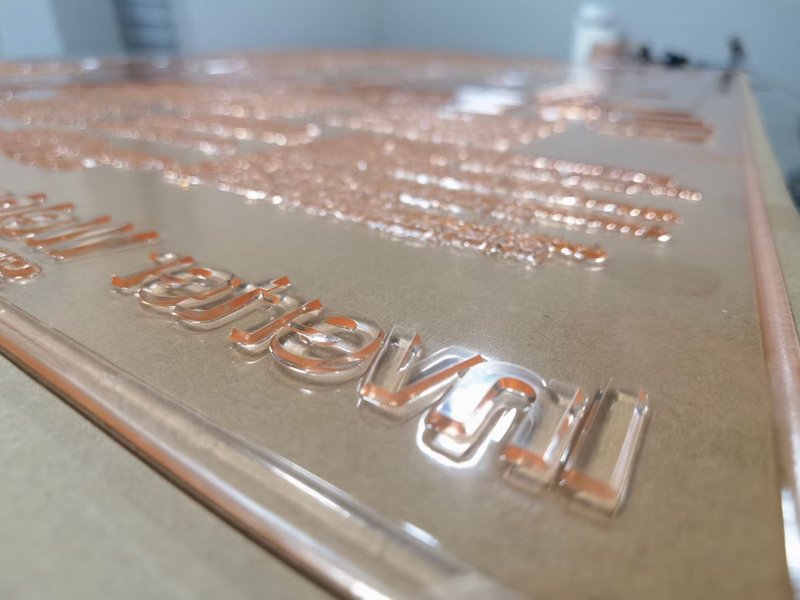
A digital flexo plate has the same photopolymer and polyester base, but the top carries a thin black LAMS (laser ablation mask) layer. A flexo imager removes this mask with an infrared laser wherever the image should print. The plate then goes to the same UV exposure unit, without film and without vacuum. The remaining black mask acts as an integrated negative.
Because the mask sits directly on the polymer, there is no air gap and no dust between film and plate. In a standard digital plate exposed in air, oxygen also slightly limits curing at the dot surface, so dots come out a little smaller and with rounded tops. This gives finer highlights, but it also explains why many plate rooms add a flat-top exposure step. We explain the difference in flat-top vs round-top flexo dots.
When to choose analog flexo plates
Analog plates are not outdated. They remain the practical choice when:
- You have no flexo imager and your film supplier gives reliable, dust-free film.
- The job is mainly line work, text and solids, such as shipping cartons, sacks and simple labels, where highlight dots are not critical.
- You print corrugated postprint on thick, soft plates, where coarse screens hide the dot size difference. See our corrugated flexo plates.
- Plate volume is low and an imager would stand idle most of the week.
A common objection is “our film workflow works fine”. If your remakes are low and customers accept the print, that is a valid position. Our analog flexo plates are made for exactly this kind of plate room.
When to choose digital flexo plates
Digital LAMS plates pay off when print quality and repeatability matter more than equipment cost:
- Process colour and vignettes on flexible packaging, labels and folding carton, where you need finer screens for packaging and clean fades.
- Repeat jobs that must match earlier runs; the same file gives the same plate, so you get consistent plates for repeat jobs.
- High plate volume, where removing film and vacuum steps means fewer remakes in the plate room.
- Brand owner requirements for tight colour tolerance.
Our digital LAMS flexo plates are available in the same processing routes and gauges as our analog range.
Can you switch or run both?
Yes. Many converters run both: digital plates for process work and analog plates for line and corrugated jobs. Because both plate types use the same back exposure, main exposure lamps, washout, drying and post-exposure, the plate room changes less than people expect. To move from analog to digital you mainly add a flexo imager. Our flexo CTP imagers are supplied with our partner factories; if you need exposure, washout and drying units, see our flexo plate processors, also supplied with our partner factories.
Before switching, run a short trial:
- Image a test form with highlight steps, fine text, reverse type and solids on both plate types.
- Process both with the settings in the grade TDS, then measure relief and minimum held dot.
- Print both on the same press, anilox and substrate, and compare dot gain and solid density.
- Build a new compensation curve for the digital plate; do not reuse the analog curve.
Cost and workflow factors
We do not quote prices on this page, because plate price depends on grade, gauge, size and volume and is confirmed in the quotation. The cost factors are clear, though:
| Cost factor | Analog | Digital |
|---|---|---|
| Plate material | Generally lower per square metre | Generally higher, because of the LAMS layer |
| Film | Ongoing cost per job | None |
| Equipment | Exposure unit with vacuum frame | Flexo imager plus exposure unit |
| Remakes | Higher risk from dust and vacuum issues | Lower risk; file-to-plate |
| Labour | Film handling, cleaning, vacuum checks | Imager loading and ablation time |
Two objections come up often: “a flexo imager is too expensive” and “digital plates cost more per plate”. Both are true on paper. The fair comparison is total cost per printed job: film, remakes, press make-ready and rejected print. For some plate rooms analog still wins on that basis, and that is fine. For our breakdown of what drives plate cost, see flexo plate price factors.
The key point: digital flexo plates are not a completely different plate. Analog and digital plates share the same photopolymer chemistry, floor and washout; digital only replaces the film with a laser-ablated mask. That makes it easy to run both and move jobs between them as your work changes.
FAQ
What is the difference between analog and digital flexo plates?
An analog flexo plate is exposed through a separate negative film under vacuum. A digital flexo plate has a black LAMS mask on its surface that a flexo imager ablates with a laser, so no film is used. The photopolymer, back exposure, washout and finishing are the same.
Are digital flexo plates better than analog plates?
Digital plates give sharper highlight dots, finer screens and better repeatability, so they are better for process colour packaging and labels. For line work, text and corrugated postprint, analog plates often print just as well at a lower total cost.
Do I need a flexo imager to use digital flexo plates?
Yes. The LAMS mask must be ablated by a flexo imager (flexo CTP). If you do not have one, a trade plate maker can image the plates for you, or you can add an imager supplied with our partner factories.
Can analog flexo plates print fine screens?
Analog plates can print moderate screens well, but the minimum highlight dot is larger than on digital plates because light spreads under the film. For very fine screens and smooth vignettes, digital plates are the safer choice.
Which flexo plate is cheaper, analog or digital?
Analog plate material is generally cheaper per square metre, but you also pay for film and for remakes. Digital plates cost more per plate yet remove film and reduce remakes. Compare total cost per job; plate prices are confirmed in the quotation.
Comparing analog and digital plates for your plate room? Request a quote with the plate type, gauge, sheet size, processing route (solvent, water-wash or thermal), ink system and monthly volume. Or request trial plates / contact us.
Disclaimer: values on this page are typical and for reference only; final specifications, MOQ, price and lead time are subject to the grade TDS and the quotation.


