
Flexo Plate Thickness Guide
Last updated: October 2026
Quick answer: Standard flexo plate thicknesses in the industry are 1.14, 1.70, 2.28, 2.54, 2.84, 3.94 and 6.35 mm (0.045″ to 0.250″). Thin gauges (1.14–1.70 mm) suit labels and flexible packaging; 2.28–2.84 mm suit wide-web packaging, bags and corrugated preprint; 3.94–6.35 mm suit corrugated postprint. The right gauge is fixed by your cylinder undercut minus mounting tape thickness.
Key takeaways
- Flexo plates come in a small set of standard gauges; your press design, not preference, usually decides which one you run.
- Plate thickness + mounting tape (or carrier/cushion) thickness = cylinder undercut.
- Thinner plates hold finer screens with less dot gain; thicker, softer plates conform better to rough board.
- Thicker plates need more distortion compensation in prepress for the same print repeat.
- Gauge tolerance and relief depth per grade are stated in the plate TDS.
Buyers rarely ask about plate thickness until something goes wrong: new plates print too much pressure on old cylinders, the image comes out longer than the artwork, or the wrong gauge was ordered and does not fit the press. This guide gives a simple table of gauge by job, then explains how thickness ties into mounting tape, cylinder undercut and distortion. It applies to all photopolymer flexo plates — analog, digital LAMS, water-wash and thermal grades alike.
Standard flexo plate thicknesses at a glance
Flexo plates are specified by total thickness, including the polyester backing. Gauges originated in inches, which is why millimetre values look uneven. Both units are used in purchase orders, and confusing them is a common source of wrong deliveries.
| Gauge (mm) | Gauge (inch) | Typical applications (industry practice) |
|---|---|---|
| 1.14 mm | 0.045″ | Narrow-web self-adhesive labels, flexible packaging, fine screens and process colour |
| 1.70 mm | 0.067″ | Flexible packaging, labels, folding carton — one of the most common general packaging gauges |
| 2.28 mm | 0.090″ | Wide-web flexible packaging, paper bags, tissue and napkins |
| 2.54 mm | 0.100″ | Wide-web packaging, paper bags and sacks on presses built for this gauge |
| 2.84 mm | 0.112″ | Corrugated preprint, multiwall sacks, paper bags, fine-flute postprint |
| 3.94 mm | 0.155″ | Corrugated postprint on B and C flute — the most common postprint gauge |
| 6.35 mm | 0.250″ | Heavy and double-wall corrugated, rough recycled liner, older box presses |
Inch and millimetre gauges confuse many buyers, so always state both on the order, plus the plate type and processing route. We manufacture flexo plates in these standard gauges; availability per grade is listed in the TDS.
Thickness by application: labels, flexible packaging, corrugated
- Labels (narrow web): 1.14 mm, sometimes 1.70 mm. Hard plates on hard sleeves or cylinders, fine screens and small type. See our digital flexo plates for label work.
- Flexible packaging (film, foil, paper): 1.14 mm or 1.70 mm on modern sleeve presses; 2.28 mm or 2.54 mm on some wide-web presses designed around thicker plates.
- Paper bags, sacks, tissue: 2.28–2.84 mm, medium durometer.
- Corrugated preprint: 1.14–2.84 mm, printed on liner before corrugating.
- Corrugated postprint: 2.84 mm for fine flutes and high-graphic boxes, 3.94 mm for general boxes, 6.35 mm for heavy board. Details on our corrugated flexo plate page.
How plate thickness affects print quality
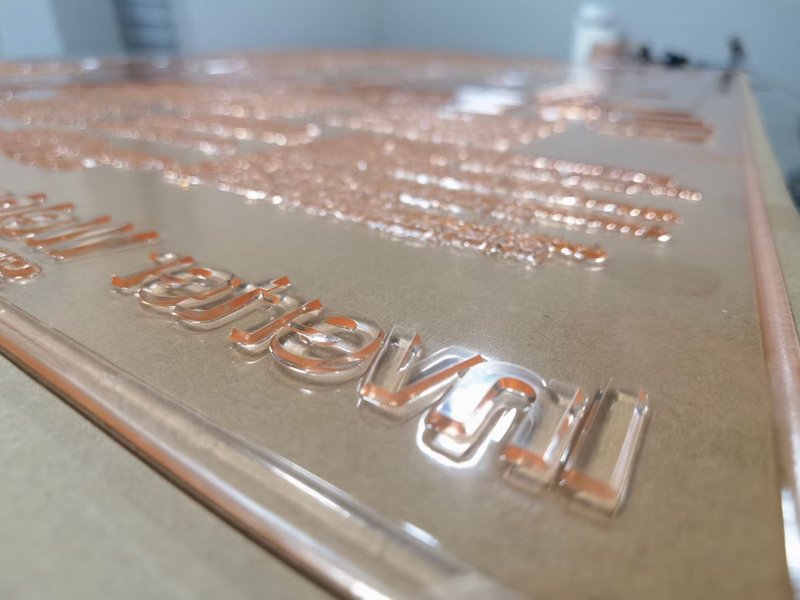
Total thickness is made of three layers: the polyester base, the cured floor and the relief (the height of the printing elements above the floor). Thickness therefore influences relief depth, plate compressibility and how dots deform under impression.
A widespread belief is that a thicker flexo plate always prints better. In practice thinner gauges hold finer screens and less dot gain, because there is less polymer to compress and bulge under pressure, while thicker gauges only win on rough or uneven substrates such as fluted board, where extra cushioning evens out solids. Durometer (Shore A hardness) works with thickness: thin plates are usually harder, thick corrugated plates softer. Buyers also object that a thinner plate will not survive their board — on corrugated that is often true, which is exactly why postprint stays at 3.94 mm and above.
Mounting tape and cylinder undercut
Plate thickness is not an independent choice. It is fixed by the cylinder undercut and mounting tape, and it sets relief, distortion and print behaviour. The undercut is how far the cylinder body (or sleeve) sits below the bearers or the print diameter, measured on the radius:
Cylinder undercut = plate thickness + mounting tape thickness (for corrugated: + carrier sheet and cushion)
| Plate | Mounting tape (example) | Required undercut |
|---|---|---|
| 1.14 mm | 0.38 mm | 1.52 mm |
| 1.14 mm | 0.50 mm | 1.64 mm |
| 1.70 mm | 0.50 mm | 2.20 mm |
| 2.84 mm | 0.50 mm | 3.34 mm |
What printers want is plate and tape that add up to the right undercut. If the sum is too large, the plate prints with excess pressure and dot gain; too small, and you lose solids. Changing thickness can mean new cylinders or sleeves, which is the usual objection to a gauge change — often a different tape thickness bridges a small difference instead. Tape compressibility (soft, medium, hard) also matters: soft tapes for solids, hard tapes for fine screens. Read more in our flexo plate mounting guide.
Plate thickness and distortion compensation
When a flat plate is wrapped around a cylinder, its surface stretches around the circumference, so the printed image is longer than the artwork. Prepress compensates by shortening the image in the around-the-cylinder direction. A commonly used approximation is:
- K = 2π × (plate thickness − polyester base thickness)
- Distortion % = K ÷ print repeat length × 100
Example: a 1.14 mm plate with a 0.125 mm base gives K ≈ 6.38 mm. On a 400 mm repeat, the image is shortened by about 6.38 mm, or 1.59%. A thicker plate gives a larger K, so the same repeat needs more compensation — one reason an image comes out longer than the artwork after a gauge change without updating prepress. Use the base thickness stated in your plate TDS; your prepress software may use its own constant.
How to choose the right flexo plate thickness
- Measure or look up your cylinder or sleeve undercut and the tape (or carrier and cushion) you use.
- Subtract the tape thickness — the result is your plate gauge.
- Check the application row in the table; if you have a choice, take the thinner gauge for fine work and the thicker one for rough board.
- Match durometer and processing route (solvent, water-wash, thermal) to your ink and plate room — see our flexo plate processors.
- Order with the gauge in both mm and inch, and ask for the same gauge every batch with the tolerance stated in the TDS.
For the full plate range, start at our flexo plates page; for offset sizes, see the printing plate size chart.
FAQ
What are the standard flexo plate thicknesses?
The common industry gauges are 1.14 mm (0.045″), 1.70 mm (0.067″), 2.28 mm (0.090″), 2.54 mm (0.100″), 2.84 mm (0.112″), 3.94 mm (0.155″) and 6.35 mm (0.250″).
What thickness flexo plate is used for labels?
Narrow-web label printing typically uses 1.14 mm plates, sometimes 1.70 mm, mounted on hard tape or sleeves for fine screens and small type.
What thickness flexo plate is used for corrugated?
Corrugated postprint typically uses 3.94 mm for general boxes and 6.35 mm for heavy or double-wall board, with 2.84 mm for fine flutes. Corrugated preprint on liner uses 1.14 mm to 2.84 mm.
How do you calculate cylinder undercut for a flexo plate?
Undercut equals plate thickness plus mounting tape thickness, measured on the radius. For example, a 1.14 mm plate on 0.50 mm tape needs a 1.64 mm undercut. On corrugated presses add the carrier sheet and any cushion.
Does flexo plate thickness affect print quality?
Yes. Thinner plates compress less and hold finer screens with less dot gain; thicker, softer plates conform to rough substrates and give smoother solids on board. Thickness also changes the distortion compensation needed in prepress.
What is the relief depth of a flexo plate?
Relief depth is the height of the printing elements above the floor. It grows with plate thickness and is set by back exposure during plate making. Typical relief per gauge is given in each grade TDS.
Not sure which gauge fits your press? Request a quote — send your press, cylinder undercut, tape, substrate, ink and plate size. Or request trial plates / contact us.
Disclaimer: values on this page are typical and for reference only; final specifications, MOQ, price and lead time are subject to the grade TDS and the quotation.

